.png)
 3 weeks ago
58
3 weeks ago
58
 Image source, BBC Sport
ByDaniel Austin
BBC Sport senior journalist
Among world football's great theatres, the Estadio Azteca might be the most majestic stage of all.
Sat squat in the south of Mexico City, a sprawling metropolis bubbling atop a high-altitude valley surrounded by mountains, the Azteca is where the colour, noise and energy of football truly come to life, and where the game's most glorious kings have been crowned.
Pele and his third World Cup win. Maradona and his goal of the century. The ultimate moments in the careers of two men lauded in every corner of the globe, both bound by the same setting - the Azteca.
Now, for the first time since being eliminated from the 1986 World Cup by Maradona's Argentina, England are entering the enormous stadium again.
What awaits them is utterly unique.
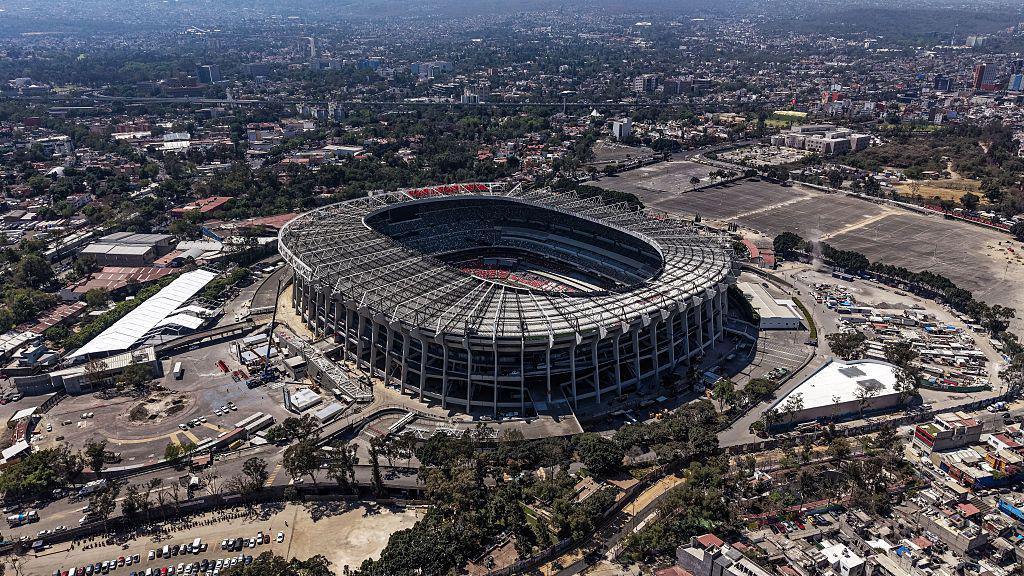 Image source, Getty Images
The Azteca has played host to some of the most memorable matches, moments, and players in football history
Built to harness the power of people
"There is just something very special about Azteca," recalled Pele later in his life. "You need to be inside it, to feel it, to understand."
The stadium's design plays a big part.
Though the Azteca has undergone multiple refurbishments since Pele's time, and its capacity has been reduced to 87,500, the core principles of the architecture which have always made it so colossal and uproarious - its steep sides, the proximity of the stands to the pitch, the underground dressing rooms and tunnels - remain.
Mexico had considered bidding to host the 1958 World Cup, but in the end didn't press ahead and allowed Sweden to win the rights. Instead, after a few years of deliberation, they set their sights on 1970 and won.
The architect Pedro Ramirez Vazquez was tasked with building a venue that could welcome over 100,000 people and rival the enormous spectacle of Rio de Janeiro's Maracana, which itself had been built specially for the World Cup in Brazil in 1950.
It was an immense feat of engineering, featuring a pioneering cantilevered roof with no columns, allowing for unobstructed views, and could only be constructed after 180 million kilos of rock were removed from the land below.
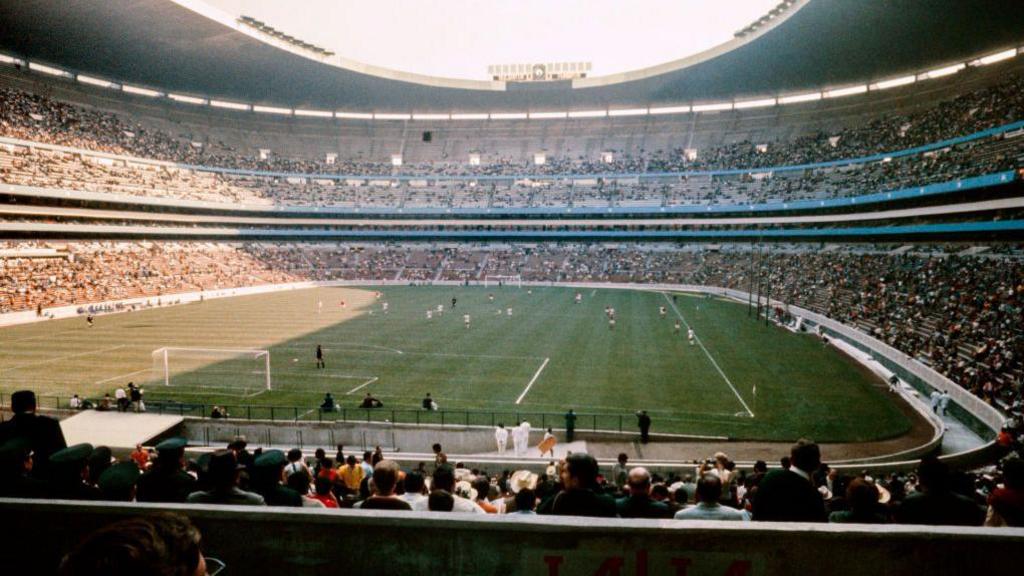 Image source, Getty Images
The Azteca first hosted an international football tournament when it held matches at the 1968 Olympics
"While I had a great passion for architecture, I had an even bigger passion for football," Ramirez Vasquez later said.
"Maracana is circular, and if people are arranged in a circle while the pitch is rectangular, the long sides of the pitch - the most interesting part - are the furthest away.
"The foundation of the design... was that each spectator should have, from any seat, the same quality view as everybody else.
"The architecture of Azteca stills feels modern - its appearance is contemporary in every respect.
"You feel enveloped. From every seat you are immersed in the game, from the front row to the very top."
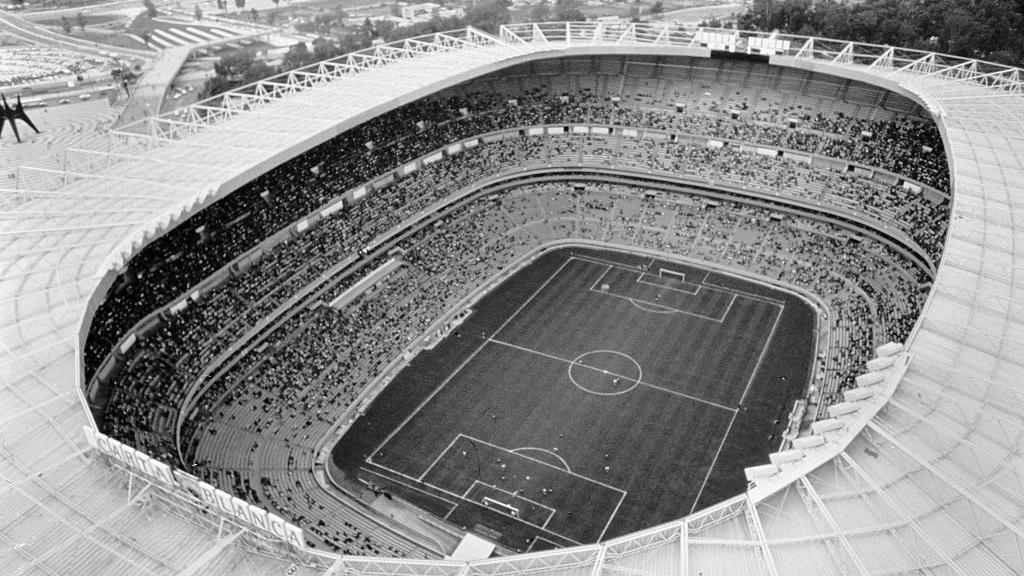 Image source, Getty Images
The Azteca's roof was only added a year after it first opened, having been built using money partly earned from ticket sales from its first events
The power of the people is what makes the Azteca truly special.
Whether cheering on Mexico, home club sides Club America or Cruz Azul, or hosting neutral sides in the World Cup, the Azteca crowd is renowned for generating a ferocious soundtrack like nowhere else.
"It is next to impossible to communicate on the pitch because the Azteca is full of sound swirling all around you", says Jason de Vos, one of the few men to have both played and coached against Mexico at the stadium, doing so with the Canadian national team.
"The Mexicans know they have an advantage because of the crowd and they try to swarm you on the pitch too.
"When you arrive the team bus drives under the stadium, down a ramp and then you walk to the dressing room.
"When you walk to the pitch you have to go through a very tight tunnel and you can hear a buzzing sound, like a swarm of bees.
"To get outside, you approach the pitch from below, going up a staircase, and when you crest the top and see the light, you realise that the buzzing is the people.
"It's the vibration of the horns, the screaming, the jumping. It's crazy
"But that's exactly why you want to play football."
 Image source, Getty Images
For generations, Mexican football fans have made the Azteca a special place to play
The home of huge football history
The Azteca is the only stadium to have hosted matches in three different editions of the World Cup - 1970, 1986 and 2026.
The first two featured some of the most iconic matches and goals in World Cup history.
The 1970 semi-final between Italy and West Germany is regarded by many as the greatest match ever played. It was 1-1 after 90 minutes, before five goals were scored in extra time, with the Italians winning 4-3.
But in the final they were defeated by Pele - winning the World Cup for the third time - and his Brazil team-mates in a side still cited as one of the greatest teams of all time.
Brazil won 4-1, and their final goal - rocketed into the top corner by full-back Carlos Alberto - was a beautiful passing move in which all but three players touched the ball, and is considered one of the best team goals ever scored.
"The atmosphere, the noise at that final was unbelievable," Alberto later said. "Wonderful, indescribable."
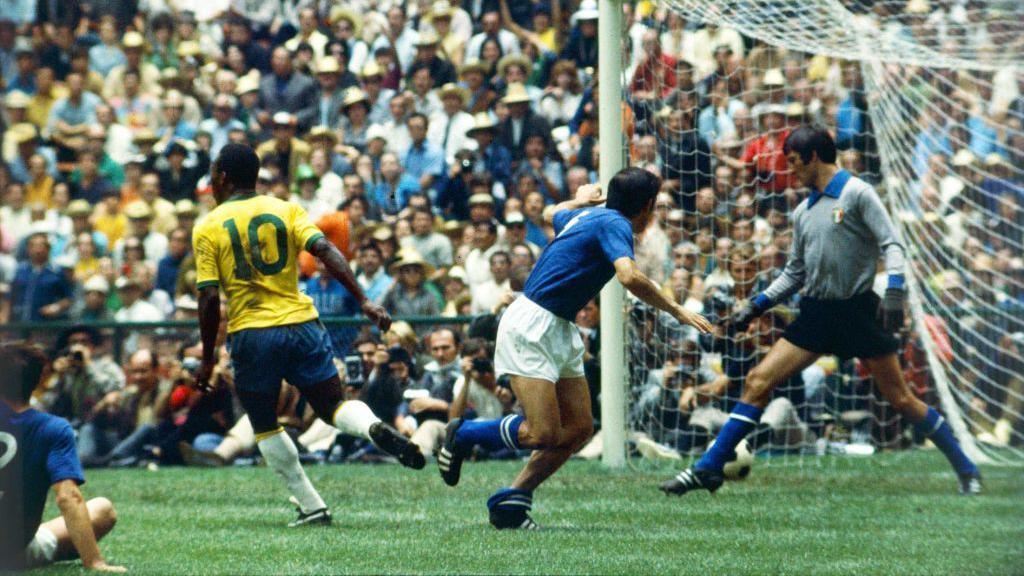 Image source, Getty Images
Pele scored four goals and made six assists in the 1970 tournament, and remains the only player to have won the World Cup three times
Sixteen years later Mexico was selected to host the tournament again, and this time it was Argentina and Maradona who shone in the Azteca spotlight.
Aged 25 and having moved to Napoli from Barcelona the year prior, Maradona delivered possibly the most dominant tournament performance in football history, scoring five goals and making five assists, to win his country's second trophy.
Against England in the quarter-final he scored two goals which are among the most famous moments in sporting history, for different reasons.
Firstly, Maradona opened the scoring in the second half with his notorious 'hand of God' goal by punching a miscued back pass with his hand past Peter Shilton and into the net.
Four minutes later, he picked the ball up inside the centre circle in Argentina's half with his back to goal. Within 11 seconds, he had danced past five England players, rounded the goalkeeper, and slipped the ball into the back of the net entirely on his own.
All four sides of the Azteca roared in adulation and astonishment as El Diego ran towards the corner flag in celebration.
In 2016, four years before his death, Maradona called it the most important match of his career.
 Image source, Getty Images
There has arguably never been a more famous goal scored than Maradona's opener at the Azteca, which Maradona himself described as scored "a little with the head of Maradona and a little with the hand of God"
Mexico dominance and altitude make Azteca even tougher
Since they began playing there in 1966, Mexico have built an immensely impressive home record at the Azteca.
In competitive matches, they have won 70 out of 89 times, drawing 17 and losing only twice, though that record can partly be credited to their historical superiority over rival nations in North and Central America.
The first defeat - 2-0 against Costa Rica in a World Cup qualifier in 2001 - was such a huge surprise that it earned its own nickname, 'Aztecazo' [the name of the stadium with a suffix that means shocking blow], and was labelled "a funeral" by Mexican newspaper Reforma.
Sitting at over 2,200m (7,220ft) above sea level, the Azteca's altitude alone makes it a gruelling challenge for footballers.
The Earth's atmospheric pressure is lower, making the air thinner and meaning less oxygen is taken into the bloodstream with each breath.
Players who are acclimatised and know how to cope with it can gain an advantage over those unaccustomed, helping Mexico maintain such a strong record over opponents.
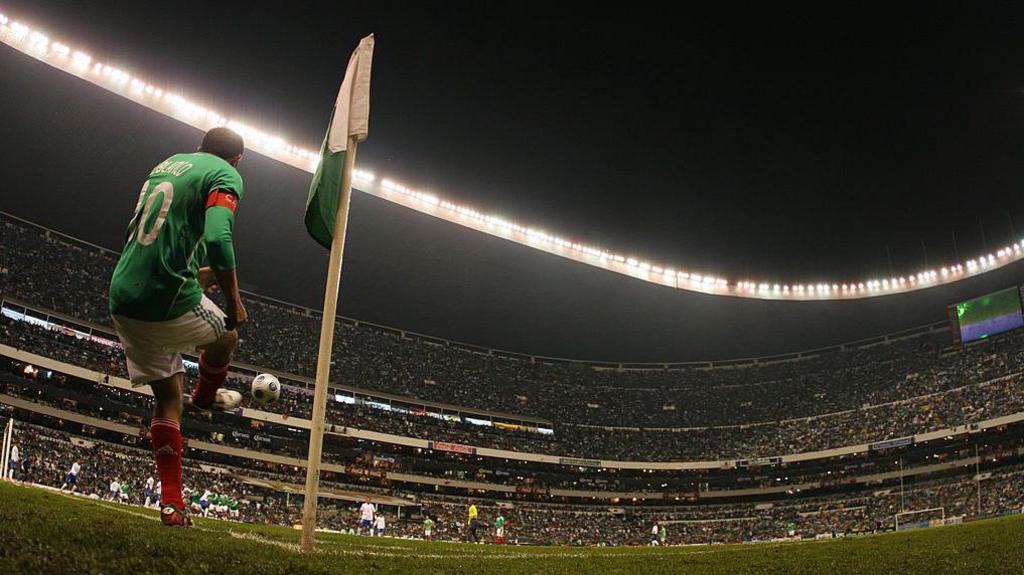 Image source, Getty Images
Legendary Mexico players including Cuauhtemoc Blanco have enjoyed great success in front of huge home crowds at Azteca
"Midfielders will usually suffer the most, because they have to move up and down the pitch and cover the most distance", says Dr Olivier Girard, professor of high performance at the University of Western Australia.
"Sometimes players start matches at altitude with the same intensity they would at sea level, and then in the middle of the first half fatigue can really set in and they can start giving scoring opportunities away more easily.
"It is absolutely both a physiological and psychological advantage for a team which is used to playing at this altitude."
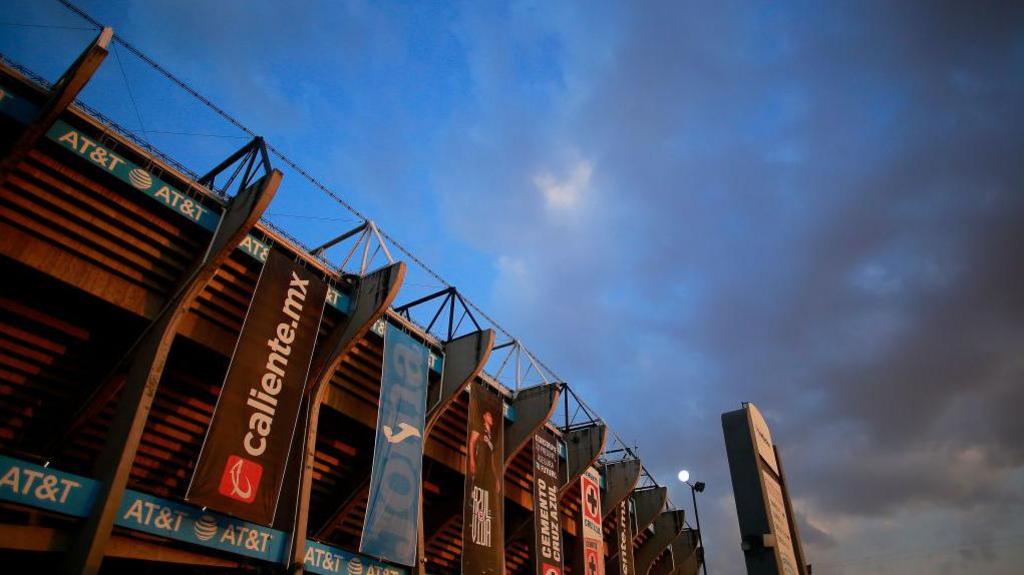 Image source, Getty Images
Club America have played home matches at Azteca since 1966, while Cruz Azul have moved in and out, and will return for a third spell later this year
For the Azteca to have played host to so many of the most illustrious moments in football history, and for Pele and Maradona to have achieved their crowning glories there, is even more impressive given the challenge posed by the altitude.
"It accentuates what they've done," says Dr Barney Wainwright, senior research fellow at Leeds Beckett University.
"It's very impressive when we see major athletic feats at this altitude in a single, long piece of play, because it's sustained.
"Playing a full match at that level is a great physical challenge in itself. To have the mental capacity to produce such skilful moments makes it extra special."
A stage fit for the Caesar of Boxing, The King of Pop, and the Pope
The Azteca is a purpose-built football stadium, but some of its most special moments have had nothing to do with the game.
In 1993 it was home to the largest crowd in championship boxing history, when 132,274 people watched national hero Julio Cesar Chavez knock out Greg Hauger to retain the WBC super lightweight title.
"It was the most incredible night of my entire career and my life," Cesar Chavez said. "Being there in the middle of the ring is something unbelievable."
The same year, Michael Jackson headlined five nights of his Dangerous World Tour at the Azteca, performing to a total of 550,000 people.
And in 1999 a mass held by Pope John Paul II in the heart of devoutly Catholic Mexico brought a crowd of over 110,000 to the stadium.
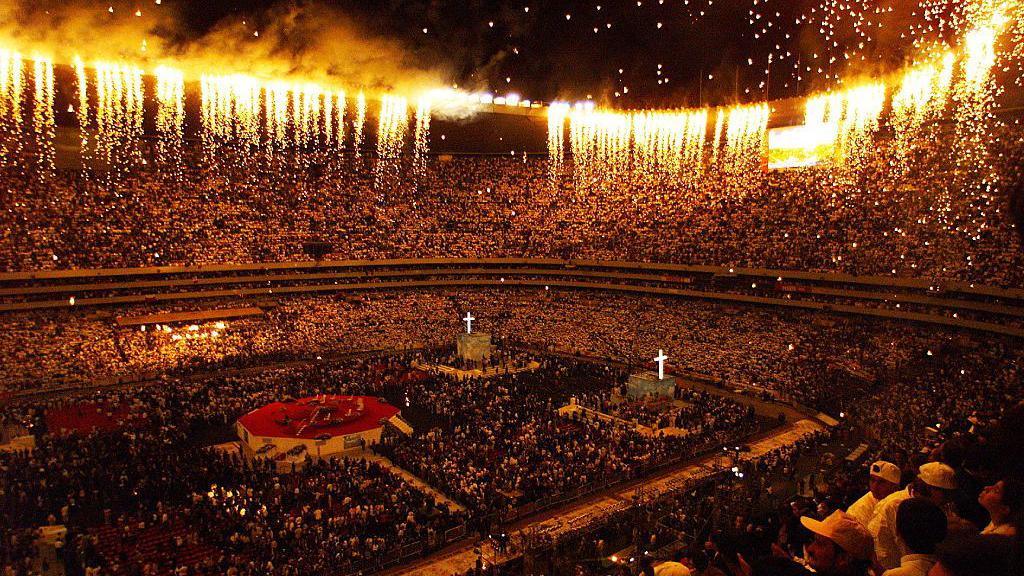 Image source, Getty Images
After the fireworks ended at Pope John Paul II's Azteca mass, he was given a rapturous ovation by the congregation which lasted for over 15 minutes as he was driven around the stadium in the Popemobile
"People who know me will attest I'm a little fond of football," the Pope said at the mass. "It is a privilege to be here, where I watched such beautiful football."
Whether it be sport, music, or religion, the Azteca is built for moments when masses of people come together to feel alive.