.png)
 1 month ago
19
1 month ago
19
The England and Wales Cricket Board will have few shots to play in its review of the Ashes tour when it meets next month to sift through the wreckage of the series. The tone and outcome of those meetings will be determined by whether England can rally or are whitewashed in Australia for the third time in six tours.
Over the past 20 years of disappointments in Australia other than Andrew Strauss’s outlier in 2010-11, the ECB has exhausted all avenues. It appointed Ken Schofield, the former executive director of golf’s European Tour, to conduct an external inquiry and then asked Strauss, England’s last Ashes-winning captain in Australia, to review the sport’s domestic structure.
After four months of work in 2007, the Schofield review was published after the start of the domestic season and included 19 recommendations, 17 of which were endorsed by the ECB. The subsequent introduction of a director of cricket, currently Rob Key, and the establishment of full-time selectors played a significant role in England recovering from their first Ashes whitewash for nearly 90 years to win in Australia four years later. Although it took longer to implement Schofield’s call to abolish the Pro40 League, it altered the structure of the domestic game.
The Strauss-led high-performance review in 2022 was more streamlined by comparison, but had less impact, with the counties rejecting his proposals for cuts to the County Championship and a six-team Division One to prepare future England players better for the challenge of playing in Australia.
After the latest defeat Strauss posted at length on LinkedIn, calling again for more to change. “We have been badly mauled time after time over there because Australia are a better team, served by a better high-performance system,” he wrote. “If we are genuinely serious about changing this depressingly one-sided story, then we need to look beyond sacking England coaches and captains and ask whether we are genuinely willing to make the changes necessary to break the trend.”
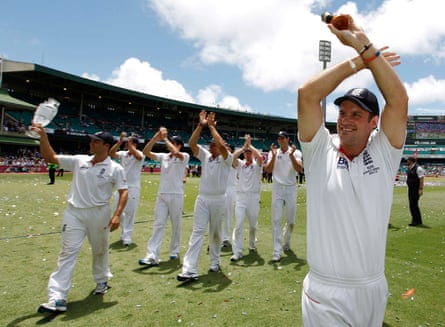
The ECB, however, is unlikely to commission any formal inquiries as, to a large degree, the governing body has lost control of cricket’s governance and operations, ceding powers to above and below. Structural changes to combat England’s continuing inability to challenge Australia in their own country, where they have not won a Test in 18 attempts since Strauss lifted the urn in Sydney in 2011, appear to be off the table.
In an unintended consequence of the summer’s £520m sale of 51% of the eight Hundred franchises, the ECB no longer has control of England’s players during the tournament, which will be played next year in July and August. For the first time since the introduction of central contracts in 2000, England’s management will be unable to withdraw players from a franchise competition. In practical terms this means any player reaching the Hundred final will be unable to practise meaningfully with England for the first Test against Pakistan, which starts two days later. Even the all-powerful Indian Premier League franchises have not been granted the control given to the new Hundred owners, with Harry Brook and Mark Wood withdrawn from duty by the ECB in recent years.
Handing over its key assets for a month to secure £520m will go a long way in safeguarding the future of the 18 first-class counties. Many of these are loss-making businesses that would go bust without central subsidy and the subsequent trade-off is widely seen to be worth making. However, continuing to allow the counties to dictate the structure of the game is more questionable.
The ECB, along with the Professional Cricketers’ Association, would like the domestic season to be streamlined to resemble more closely Australia’s Sheffield Shield, which comprises 10 four-day games for each state before one five‑day final, but has handed over responsibility for such decisions to the counties.
After the rejection of the Strauss review the ECB took a different approach to reform this year, empowering the counties’ Professional Game Board to take the lead in proposing changes, but despite coming up with five options for a new schedule they were all rejected by the county chairs. As a result, the County Championship will remain at 14 matches next season, most of which will be squeezed into the beginning and end of the season.
Given this year’s debates, which were only belatedly put to a vote during the final round of championship matches in September, meaningful structure change is likely to be off the table unless the ECB alters its constitution to put itself in charge.
While this would require a vote of the 41 constituent members of the ECB (the 18 first-class counties, the MCC, the Minor Counties Cricket Association and the 21 recreational boards), such an outcome was achieved when the Hundred was created in 2017. Given the ECB is responsible for disbursing the resultant hundreds of millions of pounds in revenue, it has considerable leverage.
A key line in the Strauss review four years ago was that deeper structural reform was required to fix the cycle of Ashes losses rather than just changing the captain and coach every four years. For the moment at least the ECB is limited to doing just that.