.png)
 4 weeks ago
47
4 weeks ago
47
The Tour de France and the heat of the midday sun are old bedfellows, going back long before an era when the biggest catastrophe of the Tour’s opening week was a major fault in the Visma team bus’s air conditioning. Flip back 50 years to my favourite Tour read, the late Geoffrey Nicholson’s The Great Bike Race, and we find the doyen of cycling writers discussing a Tour that began in baking conditions in the Vendée, and continued through the canicule in central France and Normandy.
“The heatwave,” wrote Nicholson, “is becoming a serious worry.” He describes the late Raymond “Pou-Pou” Poulidor as “an old sweat” – pun alert – “in legionnaire matters”, who was “careful to limit himself to two litres of water on a stage … it is part of the collective wisdom of the peloton that too much water leads to depression and fatigue.” Tell that to the Tour men of 2026 as they glug down one bidon after another.
Nicholson harks back to heatwaves now long forgotten; “the summer of 1951 when suffering from the Languedoc sun, Fausto Coppi lost 33 minutes on the stage to Montpellier. More recently, and nearer home, there was the dog- day Tour of 1957 when the baking roads of Normandy forced 66 of the 120 [starters] to retire.”
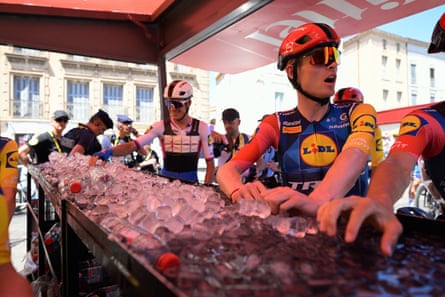
The twist is that Nicholson was describing the notorious drought year, 1976, but even so, the temperatures he describes bear little resemblance to the Tour de Furnace of 2026: 25C in the Vendée in late June, 29C on the road to Caen.
These days, as they stuff stockings filled with ice down their necks and supply urine samples to be tested for dehydration, the riders are probably longing for such conditions. “Like riding into a hair dryer,” said one of the 40-degree temperatures this week.
The primitive wisdom of yore around racing in the heat in the Tour now sounds like medieval witchcraft. In the 1960s, when Tom Simpson became the Tour’s most notorious heat victim, dying on Mont Ventoux while using amphetamines, in temperatures that allegedly burst a thermometer in the cafe on the mountain’s slopes, the race rules restricted the riders to four bidons a day (probably the basis for Pou-Pou’s two litres); two bottles at the start on their bikes, two more at the official ravitaillement (refuelling station).
Feeding from team cars was banned, until Simpson’s death eventually prompted a rethink. With no bidons coming their way, the riders raided bars en route or stopped to fill bottles at roadside springs, occasionally catching dire bacterial infections.
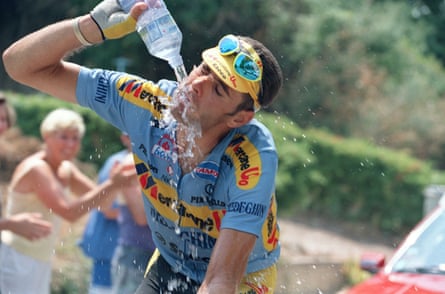
With no awareness of how heat affected the body, some riders ate salted codfish while training, to attune their systems to dehydration; as late as the 1980s, cycling magazines showed pictures of competitors stuffing cabbage leaves down the backs of their racing hats to keep the sun off the nape of the neck.
Gradually, as temperatures have inexorably risen, bike racing has had to seek out more and more inventive measures. In 2004, the Great Britain cycling team began using chairs with built-in ice baths in which riders would plunge their hands up to the wrists to lower core temperature.
It was 2010 when Team Sky, then working with Gatorade, began testing their riders’ individual mineral needs in an attempt to optimise their hydration; in the Tour that year, it was all ice baths and ice stockings.
In this Tour, a single team might get through 80 to 100kg of ice in a day; more if you include their custom-made ice lollies with personalised salt levels.
There is only so far this can go, however, as there is only so far the human body can be made to adapt. Global heating is bound to force the race organisers into some profound rethinking at some point, ironically enough for a sport where so many teams are backed by oil companies and petro-dollar regimes. This might seem unlikely, but rethinks happen fast: it is only a few years ago that there was relative insouciance about the race’s carbon profile; now, at least spectators are encouraged to attend on their bikes and the use of electric vehicles in the diesel-heavy cavalcade is rising.
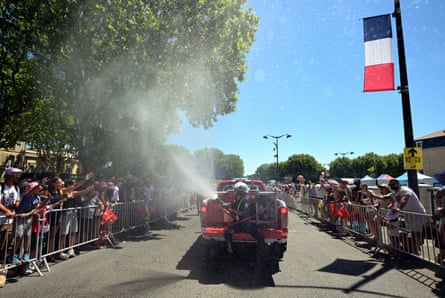
The prospect of having finishes without spectators – as happened at Les Angles this week – is not going to draw stage towns, who host the Tour, to prompt tourist spend.
In the late June heatwave, amateur races around France were cancelled or amended to avoid danger to spectators and riders and on top of the heatwave, the Tour head honchos are probably keeping an eye on extreme rainfall in the Alps, where there have been mudslides on the Col de Sarenne similar to the ones that ruined the 2019 finale.
Perhaps, sooner than we think, even the Tour’s sacred July date and primetime television late-afternoon stage finishes may have to change. The days of cabbage leaves and salted cod are long gone. Different, even more torrid times await.