.png)
 1 month ago
46
1 month ago
46
A week ago, very few people knew who Arthur Fery was. But he has been propelled into the limelight as the last man standing after a disastrous start to Wimbledon for British players.
Fery, who is ranked No 114 in the world, defied expectations on Monday night when he triumphed on Centre Court over one of the top players for most of the past decade, the former world No 3 Grigor Dimitrov.
The 23-year-old told reporters after the match that he was feeling an “unbelievable amount of emotion”.
Fery has become the first wildcard – someone ranked too low to receive an automatic place – player to reach the singles quarter-final, and only the fifth British man to do so this century.
For Fery’s former coaches, his success is no surprise. Paul Goldstein, who coached him at Stanford University, told the Guardian that Fery’s “magical run” was “so well earned, so well deserved”.
“Adjectives that come to mind are: poised, composed. If you saw what he did yesterday – the first time ever on Centre Court, playing in front of tens of thousands, many millions more watching on TV, being the last British male player standing in this event going on several days and the responsibility that comes with that – we use superlatives like extraordinary and exceptional often, but it’s so appropriate for what he did,” he said.
Goldstein, who was travelling to London on Tuesday night in the hope of securing a ticket to see Fery in his quarter-final match against Italy’s Flavio Cobolli on Wednesday, was first contacted by him when he was a teenager at school looking for a way to continue his studies and his tennis at a high level.
While he said that Arthur’s calmness under pressure was a feature of his personality, he also credited the “level of intensity that comes with playing collegiate tennis”, since it involves representing a team and the university. Fery’s unique quality was that he was “very committed, innovative, an independent thinker”, he said.
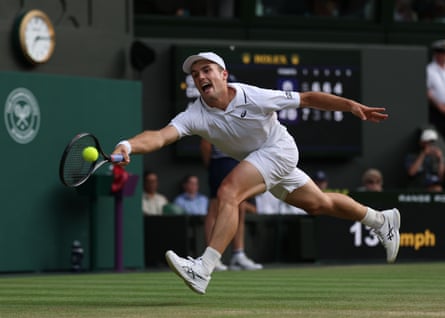
Alison Taylor, who gave private and group lessons to Fery from age four until his teens, said although Fery was “amazingly athletic”, with exceptional footwork and good hand-eye coordination from a young age, “he wasn’t the best in his age group”.
What was striking, she said, was that “he’s a real performer”, who enjoyed playing in front of others and showing off his skills. “He thrived on that, showing people that he was a good player,” she said.
He was a “dream to coach because he could do everything well”, in addition to being “quite a mature boy”, who was “also very humble, a very kind boy”.
Taylor echoed Goldstein’s observation that Fery was inclined to think outside the box. “He’s always wanted to not just be a baseliner – he’s a creative tennis player and has a lot of variety to his game.”
She added: “It’s all been a shock even to him how far he’s come – but with his confidence he can cause these top players a lot of damage … He is fearless, you didn’t see him crack under the pressure. The sky’s the limit.”
This confidence has swiftly become his signature, according to several former tennis stars. “The hard part for any tennis player is between the ears. And he has that sort of swagger and belief. That gets you a long way in this sport,” said Greg Rusedski, former British No 1 who has practised with Fery.
Fery was born near Paris and moved to England aged two. He grew up in Wimbledon, 10 minutes away from the All England Club, and attended King’s College School, a local private school.
He has chosen to play for the UK despite his French heritage. His mother, Olivia, was a professional tennis player and his father, Loïc, was a businessman who in 2023 was ranked as France’s 389th richest person.
Fery first picked up a racket aged five, moving into the Lawn Tennis Association system as a junior before taking time out to study science, technology and society at Stanford University in California, which he described as a “great kind of backup plan if tennis didn’t work out”.
In his second year Fery became the first No 1 ranked singles player in the country to attend the university since Bob Bryan, who went on to become a doubles Olympic champion.
Bryan said that Fery was well respected and a “quiet leader” at Stanford, adding that he had been “very impressed” to see him play at the university, comparing his build and style to Japanese tennis player Kei Nishikori.
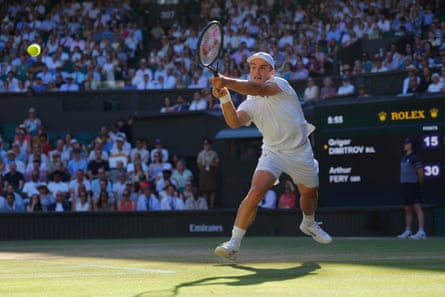
Jamie Murray, former Doubles no 1 and brother to British No 1 Andy Murray, said “a lot of people within British tennis had a lot of belief in him and what he could do”.
Whether Fery’s height poses a disadvantage to him has been a subject of much discussion. At 5’9”, he is UK male average, but four to five inches shorter than the standard professional tennis player.
“Obviously he’s a short king,” said former women’s No 1 Johanna Konta. “So he doesn’t have the height advantage, but my goodness he makes up for it with how explosive he is. I think that backhand is incredible, and again his fighting spirit.”
At Wimbledon, Fery has enjoyed having “the crowd obviously completely behind me” – with fans chanting nautical puns such as “all aboard the Fery”.
Carrying the weight of a nation’s expectations on his shoulders, Fery, who will break into the world’s top 100 for the first time after Wimbledon, is determined to keep a level head. “What I experienced [on Monday] personally, I’m really going to cherish it for the rest of my life,” he said.
“Who knows, that might be the first and last time. Hopefully not. So yeah, I’m just trying to really soak it all in and keep the memories.”