.png)
 2 hours ago
1
2 hours ago
1
Ruth CleggHealth and wellbeing reporter

 Kristian Johnson/BBC
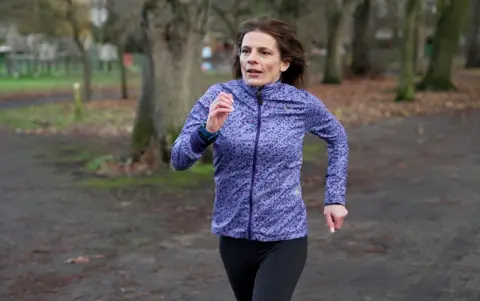
Ruth Clegg can't help but check her smartwatch countless times during a race
There's a feeling of anticipation. I can see the cold breath coming from my competitors as they do the "about to run" wiggle on the start line.
A quick flick of the hips.
I'm at my local 5km community parkrun event on a Saturday morning and I mean business. Three, two, one...
Oh, hang on. I need to sort my Garmin. As does the guy next to me.
The person behind us tuts. I'm not moving until… yes! GPS ready, I'm off.
In the mele, it's hard to see a wrist without a smartwatch on it. And it's not just us runners who use them.
It's a booming, multi-billion pound industry. Names like Apple Watch, Samsung Galaxy, Garmin, Huawei Watch and Google's Fitbit dominate, each with an extensive selection of different models to suit a range of lifestyles. Depending on how high tech the model you go for, prices can range from £100 to thousands of pounds.
"It drives me insane, I can't switch off."
"It comforts me… It's like a friend supporting me."
"Stop telling me I've had a bad night's sleep."
Just some of the comments I've had from fellow smartwatch wearers when I ask what they think of theirs.
 Kristian Johnson/BBC
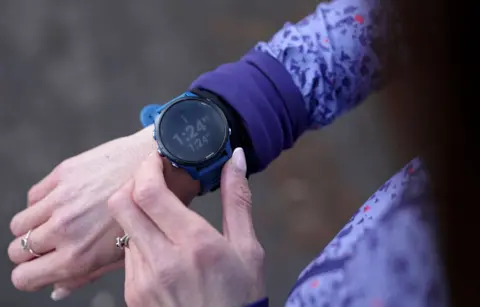
Ruth has been left wondering whether what she's looking at on her watch is accurate
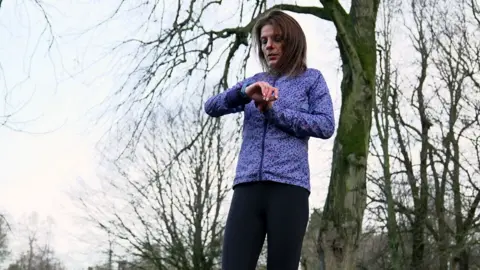
My thoughts on mine? Right now, annoying. It's telling me I'm off pace, making me wonder whether the trees I'm running below are blocking my GPS connection.
Millions of us strap these little monitors onto our wrists and wear them 24/7, seemingly at ease with the fact they're constantly tracking us.
Gone are the days when we relied on them solely to give us an idea of our step count. Now, they can measure our sleep patterns, blood pressure, heart rate, heart rate variability (HRV), our oxygen, our glucose levels, our VO2 max.
It's tricky to find a bodily function they don't track.
But do they do what they say they do? And are the statistics we analyse a reflection of reality? Do they improve our mental and physical wellbeing, or do the multitude of measurements and motivational messages just add to our daily stresses?

Rachael says some of the functions on her smartwatch are "overwhelming"
"I do get a bit obsessed with mine," Rachael Fairclough from St Helens on Merseyside, tells me.
While she loves how her Apple Watch tracks her runs, she finds some of its other functions "overwhelming" at times - as she first discovered when she became pregnant.
Before she realised she could put it into pregnancy mode, Rachael's smartwatch kept telling her she was not being productive enough. Now she's had her baby, the watch keeps telling her she's had a bad night's sleep.
"I've got a six-month old, I don't need to be told I've not slept," Rachael says. "I know that only too well."
Couldn't she just take it off?
"I could, I suppose, but I've got this love-hate relationship with it," she says. "I love it for its fitness insights, I just wonder whether all the other things it can now do is perhaps too much for me."
Each model of smartwatch has its own novel way of tracking your vitals and interpreting your data, but the majority use sensors on the back of the watch.
They usually shine small, green LED lights onto your wrist which can monitor blood flow, detecting your pulse rate. More advanced devices detect changes in the electrical current that runs through the skin to get an idea of your stress levels.
Niels Peek, Professor of Data Science at the University of Manchester, says that in general for smartwatches, it's a "fine balance" - while the ever-evolving tech could actually save lives, "detecting disease before we show symptoms", it could also turn us watch wearers into the "worried well".
He says some of the latest wearables can carry out tests like electrocardiograms (ECGs), which constantly monitor how healthy the heart is. They can flag if someone is having an atrial fibrilliation (AF), where there is abnormal electrical activity in the heart causing an irregular heartbeat.
This does not mean someone is about to have a heart attack, but it can give an early warning they might be more at risk of a stroke, blood clot or heart problems in the future.
But how to interpret these figures is complex. Prof Peek fears that as more functions are added, people may not be able to fully understand their data.
"I'm not entirely convinced being able to monitor so many things is such a good idea," he says.
Clinical psychologist and professor in cardiology Lindsey Rosman, agrees. She's carried out research into the impact of wearable tech on a cohort of cardiovascular patients.
While it's a small, specific patient group and not the general population, her study suggested 20% of those who were given wearable tech to monitor their heart health experienced anxiety and were "far more likely to use healthcare resources".
She saw a pattern with her patients - they saw a worrying figure on their watch. They became worried. Their heart rate went up. They got more worried. They checked again, and their heart rate increased again.
"If we see stats about ourselves that we don't really understand then, of course, we are going to want to know more," Prof Rosman says. "We check, we check again - it becomes a self-fulfilling prophecy."
 Mark Morton
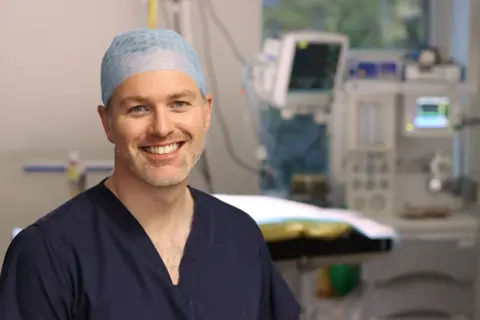
Mark Morton says his fitness tracker has improved how he sleeps
Some people have a slightly healthier relationship with their tech.
"It's not going to make me an Olympic athlete or anything," Mark Morton, a specialist vet from Cheshire, tells me about the Whoop device strapped around his bicep, "but it has really made me think about my health".
The 43-year-old dad-of-two wears a fitness tracker which gives him a daily rundown of how he's slept.
"It's completely changed my attitude to sleep," he says. "I used to have a beer, just one or two, near bedtime to unwind, but then I've seen how it messes up the quality of my sleep."
He now wears a sleep mask, sleeps in a cool room and tries not to eat or drink later in the evening - all of which have contributed to him feeling better when he wakes up, which in turn is reflected in his data.
Back on my parkrun and you'll be relieved to hear I've picked up the pace. My legs are beginning to hurt though and there's that slight incline round the corner. I check my watch again.
I've got 1km left and someone is trying to talk to me, asking me about my pace. No time for that, mate. I glance at my watch for what feels like the 6,350th time. Is what I'm looking at accurate?
"It depends on what you mean by accurate," Dr Kelly Bowden-Davies, a senior lecturer in the Department of Sport and Exercise Sciences at Manchester Metropolitan University, says.
 Getty Images
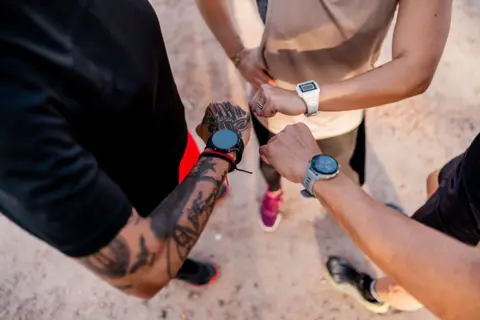
There are many smartwatch brands out there, ranging hugely in price
"They're not going to give you laboratory quality results. They don't give you a true reading of your speed or pace in a given moment."
There are too many variables - the GPS is not always reliable for a start, she cautions. Then, if our watch moves around on our wrist, it might not capture all the data it needs for an accurate assessment.
Dr Bowden-Davies says that because they're not subject to the same regulations as a medical device, they can't give us a true picture of our health. But what they can give us is a baseline to work off, she says.
"That baseline might not reflect reality to the second, or the calorie, or the metre, but it's personal to you," Dr Bowden-Davies explains.
"You can then figure out how well you are doing - if you've got faster, or you've slept better, or you've burnt more calories. They're really useful for that."
For many of us, these watches are purely a personal thing - we care about how well we've done in comparison to how we've done before. And don't get me started on the watches that let you track and compete with your friends.
I've just crossed the line at parkrun and stopped my watch - 22 mins and 28 secs.
It's not a PB, but I'm chuffed and my sprint at the end was exceptional, if I do say so myself.
Right, I'm off. I've got some data to scrutinise.
 Kristian Johnson/BBC
Ruth checking her smartwatch for the 6,351st time