.png)
 1 month ago
48
1 month ago
48
4 hours ago
Lyse DoucetChief international correspondent, in Islamabad

 Getty Images
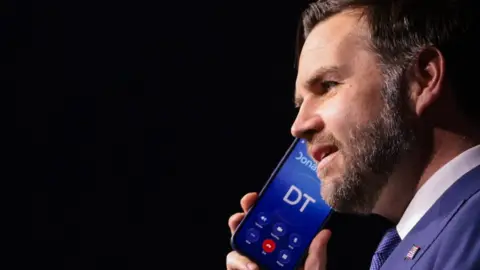
File photo of US Vice-President JD Vance on the phone with Donald Trump during a recent trip to Hungary
Twenty-one hours was not enough to end 47 years of hostility between Iran and the US.
The historic high-level talks in Islamabad, during a pause in weeks of grievous war, were always unlikely to end any other way.
Calling this marathon negotiating session a failure belies the scale of the challenge in narrowing wide gaps on complex issues ranging from age-old suspicion about Iran's nuclear programme to new challenges this war has thrown up - most of all Iran's control of the strategic Strait of Hormuz, whose closure is causing economic shocks worldwide.
To do a deal, they also needed to overcome a deep chasm of distrust.
A day ago, it wasn't even certain the two sides would meet, and even more, sit down in the same room.
A longstanding political taboo was broken.
The urgent question now is: what happens next?
What happens to the contested two-week ceasefire which pulled the world back from US President Donald Trump's alarming threat to destroy a "whole civilisation" in Iran?
Would the US president be ready to send his negotiators back to the bargaining table?
We're hearing reports from sources here in Islamabad that some conversations have continued after US Vice-President JD Vance boarded his plane at sunrise, declaring the US delegation had made their "final and best offer".
Will the US now escalate or negotiate?
We still don't know enough about what happened behind tightly closed doors in a five-star hotel in leafy locked-down Islamabad during talks that went on long into the night.
There are still few details on the disputes and discussion between the two sides, assisted by Pakistani mediators, the calls to and from experts, advisers, and, according to Vance, "dozens" of calls to Trump himself.
The vice-president spoke of the "core goal" of the US during his brief dawn news conference.
"We need to see an affirmative commitment that [Iran] will not seek a nuclear weapon and they will not seek the tools that would enable them to quickly achieve a nuclear weapon," he said.
During the last round of talks in February, before military strikes were unleashed again, Iran had offered new concessions including the dilution of its 440kg stockpile of uranium enriched to 60% - dangerously close to weapons-grade.
But it still insists on its "right" to enrich and hasn't been willing to give up that stockpile, now said to be buried deep in the rubble after US and Israeli air strikes last year.
It's also refused repeated demands to open the Strait of Hormuz - to allow the free flow of vital traffic in oil, gas and other essential goods - in the absence of a new agreement.
 EPA
EPA
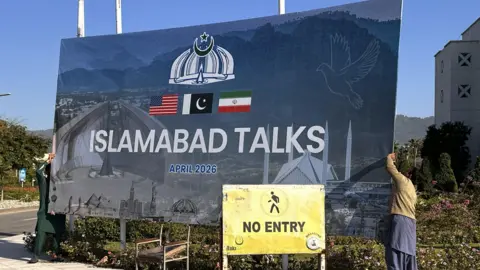
Signs hailing the talks were taken down on Sunday after they wound up
Both the US and the Iranian delegations came to Islamabad emboldened by their belief that theirs was the winning side in this war.
And they engaged knowing that, if they failed, there was the option to keep fighting – whatever the spiralling pain for their own people and a world reeling from the cost of this conflagration.
There was also what Dr Sanam Vakil of Chatham House describes as a "limited psychological understanding of the adversary and what compromises are needed for a real deal".
Vance spoke of good news – "we've had a number of substantive negotiations" - and there was bad news: "We have not reached an agreement."
And he made it clear that was "bad news for Iran much more than the United States of America".
Iran's foreign ministry spokesman Esmail Baghaei criticised the US's "excessive demands and unlawful requests" in a post on X.
And its parliamentary speaker Mohammad Bagher Ghalibaf, who led Iran's negotiating team, wrote that "the opposing side ultimately failed to gain the trust of the Iranian delegation in this round of negotiations".
Iran is indicating it's ready to keep talking. Pakistan's Foreign Minister Ishaq Dar urged all sides to uphold the fragile ceasefire and said they would continue their efforts to encourage dialogue - sentiments being echoed in other concerned capitals.
If history provides any lessons, the last time Iran reached a nuclear deal with the US and other world powers in 2015, it took 18 months of breakthroughs and breakdowns.
Trump has made it clear he doesn't want to get bogged down in protracted negotiations. Vance previously warned that the US would not be receptive if Tehran tried to "play us".
Pakistani journalist Kamran Yousef - in a legion of journalists who pulled all-nighters to provide non-stop coverage with very few details - declared that this round was one of "no breakthrough but no breakdown either".
The world waits for a verdict.