.png)
 3 weeks ago
65
3 weeks ago
65
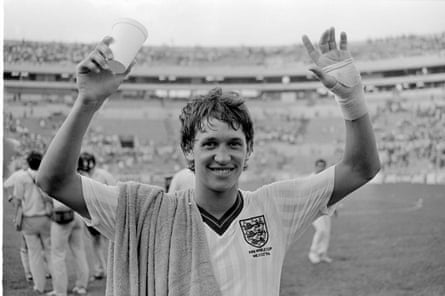
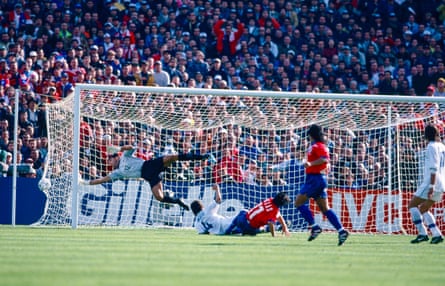
“In 1986, Gary Lineker scored six of England’s seven World Cup goals,” writes Brendon O’Mahony. “Has anyone scored a higher proportion of their country’s goals at a World Cup? Let’s exclude teams who were knocked out in the group stage or who scored three goals or fewer”
A number of you mentioned Oleg Salenko, the Russian striker who matched Lineker by scoring six of their seven goals at USA 94. That included five in one game against Cameroon, which turned out to be Salenko’s last in international football at the age of 24. Russia went out at the group stage despite Salenko’s romp, so he doesn’t meet the criteria laid out in Brendon’s question.
But there are dozens of net-botherers who do. Enormous thanks to Mirosław Skaczkowski, who has been through every men’s World Cup and confirms that Gary Lineker is indeed top of the list. In winning the Golden Boot at Mexico 86, Lineker scored 85.71% of England’s goals (Peter Beardsley scored the other one, in case you were wondering).
Second on the list wasn’t even a centre-forward. Northern Ireland’s Peter McParland was rated by Jimmy Greaves as “one of the most dangerous wingers I have ever seen, cutting through defences at tremendous speed and finishing with cannonball shots”.
McParland scored five of Northern Ireland’s six goals at the 1958 World Cup, including both in a 2-2 draw against the defending champions, West Germany, and two more in a 2-1 playoff win over Czechoslovakia. That took Northern Ireland into the quarter-finals, but it was their third match in five days and they were hammered 4-0 by France.
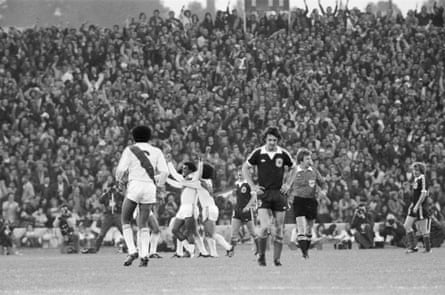
Other players with at least 60% of their teams goals at a World Cup include Peru’s Teófilo Cubillas, insouciant destroyer of Scottish dreams in 1978, Chile’s Marcelo Salas in 1998 (remember his mighty leap against Italy?) and the Italian giant Christian Vieri. He looked irresistible in 2002 until a costly miss against the co-hosts South Korea. (Go to 89 minutes of this minute-by-minute report, or fire up YouTube.)
Thanks again to Miroslaw for providing us with all the information needed for this list.
-
85.71% Gary Lineker (England, 1986)
6 out of 7 goals -
83.33% Peter McParland (Northern Ireland, 1958)
5 out of 6 -
80% Marcelo Salas (Chile, 1998); Jon Dahl Tomasson (Denmark, 2002); Christian Vieri (Italy, 2002); Robert Vittek (Slovakia, 2010)
All 4 out of 5 -
75% Luis Artime (Argentina, 1966)
3 out of 4 -
71.43% Teófilo Cubillas (Peru, 1978)
5 out of 7 -
66.67% Anatoliy Byshovets (USSR, 1970); Michel (Spain, 1990)
Both 4 out of 6 -
62.50% Roberto Baggio (Italy, 1994)
5 out of 8, including 5 out of 6 in the knockout rounds. Another Baggio, the unrelated Dino, scored two of Italy’s other three goals.
International glory, domestic drought
“The German great Thomas Hässler won the World Cup in 1990 and the European Championship in 1996. His club career was considerably less glittering, netting only a solitary Intertoto Cup trophy with Karlsruhe. That means he won one more winner’s medal as a national player than with clubs. Has anyone exceeded his tally by two or more international honours?” wonders Kári Tulinius.
A single Intertoto Cup is an unworthy legacy at club level for a player of Hässler’s mischievous brilliance. He came close to more significant honours on several occasions, most notably at the start of his career when Köln lost the Uefa Cup final to Real Madrid in 1986. But as Kalen Kasraie points out, he’s not the only late-1990s German footballer to win more trophies for country than club.
“Hässler’s teammate Andreas Köpke won the same international honours he did but his only trophy at club level was the 2. Bundesliga title with Nürnberg in his last professional season,” writes Kalen. “Ramón Ramírez, the Mexican midfielder, won three Gold Cups and the 1999 Confederations Cup with his country, but only won one title at club level, with Chivas.
Bettering all these achievements is current Atlético Madrid and Argentina full-back Nahuel Molina, who has won the World Cup and two Copa Américas with his country, not to mention the Finalissima against Italy in 2022. At club level, he has won nothing at all.” Molina came close to domestic glory last season, featuring in Atleti’s Copa del Rey final loss to Real Sociedad.
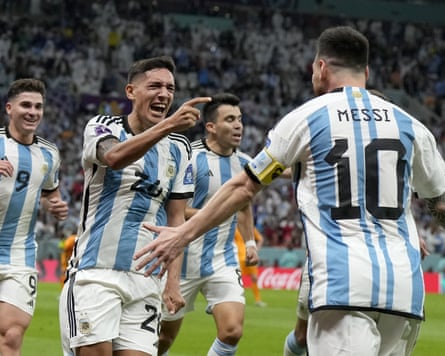
As Dirk Maas points out, Tottenham’s Cristian Romero has won the same international tournaments as Molina with a single club honour to his name, the 2025 Europa League. Another of that triumphant Argentina team, Rodrigo De Paul, has a country:club ratio of 4:2 after winning the MLS Cup and Eastern Conference with Inter Miami. Gerónimo Rulli’s ratio is 3:1 after the keeper won the Europa League with Villarreal in 2021.
Dirk also found three more examples from the back end of the 20th century: the Argentina pair of Sergio Vázquez (4:2) and Claudio Garcia (3:1), plus France’s Albert Rust (3:1).
For the purposes of this answer, an Intertoto Cup counts the same as a Champions League – and the same applies at international level. “God bless the British Home Championship, which gives us a few very good answers,” writes Daz Pearce. “Sir Tom Finney runs away with it as he participated in 10 Home Championship-winning teams with England. The only trophy he won at club level was the old Division Two title with Preston.”
Socceroos rule the world
“What’s this I hear about Australia being unofficial world champions?” asks Alf Mangle.
This is based on the old winner-stays-on format, going right back to the first men’s international fixtures in the 1870s. A very long list of relevant matches – all 1045 of them – can be found here.
Argentina ended Qatar 2022 as both official and unofficial world champions. Since then, the lesser, largely meaningless crown has changed hands as often as Ferris Bueller skipped school.
-
Argentina 0-2 Uruguay (World Cup qualifier, 16 November 2023)
-
Uruguay 1-2 Côte d’Ivoire (Friendly, 26 March 2024)
-
Sierra Leone 1-0 Côte d’Ivoire (Afcon qualifier, 15 October 2024)
-
Sierra Leone 1-2 Liberia (African Nations Championship qualifier, 27 October 2024)
-
Algeria 5-1 Liberia (Afcon qualifier, 17 November 2024)
-
Sweden 4-3 Algeria (Friendly, 10 June 2025)
-
Kosovo 2-0 Sweden (World Cup qualifier, 8 September 2025)
-
Kosovo 0-1 Turkey (World Cup playoff, 31 March 2026)
-
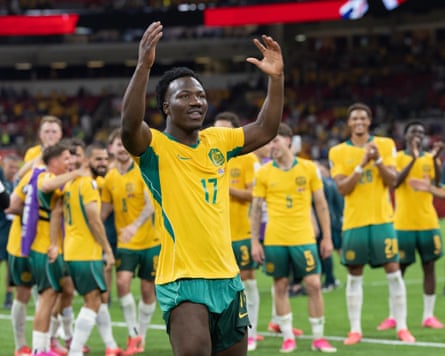
Australia 2-0 Turkey (World Cup Group D, 13 June 2026)
Australia’s next game is against the United States on Friday. For the love of sanity, nobody tell the White House that the USMNT could become world champions, unofficial or otherwise.
Knowledge archive
“Mexico, Sweden or Germany could go out of the tournament despite winning two of their group games,” noted Paul Blandon in 2018 [In the end they didn’t because Germany lost to South Korea – 2026 ed.]. “Has this ever happened before? And on the flip side, who are the worst-performing teams to get out of their group?”
Only one team has been eliminated after finishing third despite winning two of their group games: Algeria, whose loveable 1982 team were stitched up by West Germany and Austria. But this question is muddied slightly by the fact that, from 1986 to 1994, the four best third-placed teams also qualified for the last 16. Had only the top two teams in each group gone through, both Argentina and Belgium would have been eliminated in 1994 despite winning two of their three matches.
As for the worst-performing teams to qualify, let’s start at the top: Italy, who finished second in their 1982 group after drawing all three games – and then went on to win the tournament.
In 1986, two teams snuck through as one of the “best” third-placed sides after recording two draws and a defeat: Bulgaria and Uruguay after their infamous 0-0 draw with Scotland.
Since the tournament went to 32 teams in 1998, and back to the old system in which only the top two teams qualified, Chile have the worst record of a team to reach the last 16. They failed to win a game at France 98 but got through with three draws.
2026 update: at the last two men’s World Cups, no team has qualified for the knockout stage with fewer than four points or been eliminated with more than four. That may change now that some third-placed teams will go through to the last 32.
Can you help?
“Sweden’s Yasin Ayari has a Tunisian father and chose not not to celebrate his first goal against Tunisia (he couldn’t resist celebrating when he scored later though). Declan Rice did something similar after scoring against the Republic of Ireland in 2024, but what is the earliest example of a player not celebrating a goal at international level because of a connection to the opposition?” asks Michael Pilcher.
“Two questions on Dick Advocaat,” begins Luke Carruthers. “1. He has coached eight different men’s international teams – can anybody beat that? 2. He has managed the Netherlands men’s and women’s teams at senior level. How rare is this?”
“The three goalkeepers in Scotland’s World Cup squad played a combined total of four league games in 2025-26. Even if you include cup games, they only managed seven appearances. Has a World Cup squad ever contained a complement of custodians with less collective game time?” asks Al Pollock.
“New Zealand’s Chris Wood and Tommy Smith are playing at their second World Cup, 16 years after their first,” writes Alexander Scott. “Has any player had a longer wait between World Cup appearances?”
“Morocco’s starting XI against Brazil were all born in another country,” notes Alexey Svirin. “Who were the first international team to field such an XI?”
“Before signing Marc Cucurella, Real Madrid had no players in Spain’s squad, but 11 of their players are at the World Cup with other countries,” notes Tom Pinder. “Has any other club provided so many players at a finals, without a representative of the (participating) country where they are based?”
-
We’ll have another World Cup Knowledge special next week. Send your World Cup questions and answers to [email protected].