.png)
 1 month ago
34
1 month ago
34
Paul AdamsDiplomatic correspondent, Kyiv

 BBC
BBC
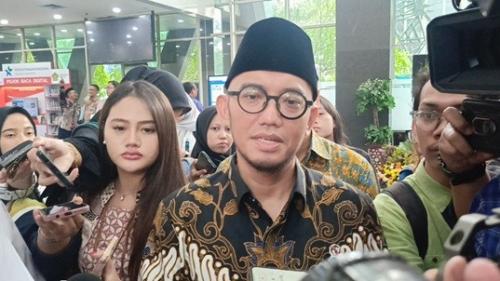
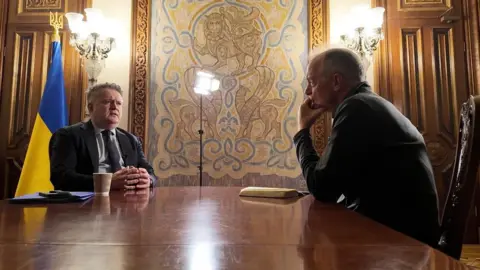
Serhii Kyslytsia (left) speaks to the BBC's Paul Adams
What is it like negotiating with the Russians over the war in Ukraine?
It is a question many are interested in knowing the answer to following several recent rounds of peace talks, which have so far appeared to bear little fruit four years after Russia's full-scale invasion.
Another round of the US-mediated discussions is likely to take place in Geneva later this week. Ahead of it, the BBC has spoken to Serhii Kyslytsia, a member of Ukrainian President Zelensky's delegation, who has taken part in the recent military-to-military discussions.
According to Kyslytsia, these dealings are business-like and generally free of the sort of political and historical grandstanding seen elsewhere by Moscow.
"The military has a better understanding of what is going on in the battlefield," he told me when we met in the presidential palace on Monday morning.
"It's another thing whether they [the Russians] are capable, or not, of reporting [back] directly…without cooking or changing the information," he added.
It is not an easy thing to try to end a war. The nature of the battlefield in eastern Ukraine - where thousands of drones patrol and kill over a huge so-called "grey zone" between the two sides, while 200,000 Ukrainian civilians still live in the "fortress belt" cities of the Donbas - makes the technical business of disengagement highly complex.
"You have to have a clear set of rules and protocols," Kyslytsia said, "and a way to verify and monitor."
Much of this work, he said, is complete, thanks in part to the close involvement of US officials, including General Alexus Grynkewich, Nato's top commander in Europe, and Dan Driscoll, Secretary of the Army.
It's obviously not in Kyiv's interest to criticise representatives of the Trump administration, but when Kyslytsia compliments the US delegation for its efforts, he sounds genuine.
"We have to credit the Americans for their commitment and their patience," he says, "because they sit in the meetings non-stop. They don't only observe…they put questions and they listen to our answers."
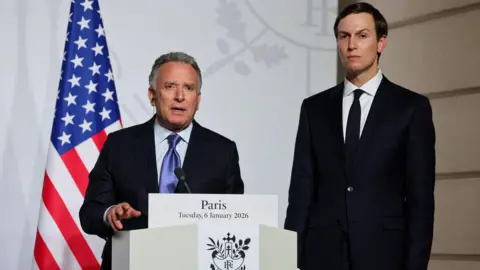
Kyslytsia was equally positive about the roles played by Donald Trump's son-in-law, Jared Kushner, whom he described as "not a novice", and billionaire all-purpose envoy, Steve Witkoff, whom he described as "a much wiser person than the caricature image you see in the media".
The US, Kyslytsia said, will play a key role in monitoring any future ceasefire, with resources including satellite and other forms of high-tech monitoring.
"We need someone who will play the role of adjudication, because if there is a violation there should be a third party that is solid [and] authoritative."
 Reuters
US Special Envoy Steve Witkoff (left) and Jared Kushner have both been involved in efforts to try and end the war
For eight years before Russia's full-scale invasion in 2022, this monitoring role was played by the Organisation for Security and Cooperation in Europe - a group whose limited resources and lack of enforcement mechanisms rendered it largely incapable of preventing an escalation.
"It was quite an achievement [for them] just to have two UAVs flying over the territory," Kyslytsia said. "It's kind of the Flintstones era compared to what we have today."
In comparison, recent reports suggest that as many as 12,000 drones are operating over the single city of Pokrovsk at any one time.
I asked Kyslytsia, who is also a former UN ambassador, how he managed to sit across the table from emissaries from a leader in the Kremlin who has been willing to sacrifice more than a million of his own men to subjugate Ukraine.
He told me he'd had years of practice.
"I saw much worse. I spent five years in New York, three of them before the full-scale invasion. I would sit in the room with the enemy on a regular basis."
One evening is seared in his memory: 23 February 2022.
In the middle of an emergency UN Security Council meeting, convened to discuss the urgent crisis in Ukraine, the ambassador got word that his country was under attack.
At the same time, seven time zones to the east in Kyiv, I remember hearing the first distant explosions as Russia's all-out assault on Ukraine began.
Amid scenes of agonising drama, Ksylytsia tried to get Russia's ambassador, Vassily Nebenzia, to call his boss, Foreign Minister Sergei Lavrov, to seek assurances that Russian troops would not invade.
"I've already said everything I know today," Nebenzia replied, according to Kyslytsia. "I'm not going to wake Minister Lavrov at this time."
Everyone's lives changed at that moment. Kyslytsia stayed at the UN for another three years before returning to Kyiv.
If the delegations meet again in Geneva on Thursday, he'll be there, still thrashing out the contours and mechanics of a ceasefire but waiting all the while for the most important part of the jigsaw to fall into place.
"The war could be stopped by just one call of one person to his military chief of staff," he said.
"But apparently, the Kremlin dictator [Russian President Vladimir Putin] is not up to stopping the war for the time being."