.png)
 1 month ago
36
1 month ago
36
Anthony ZurcherNorth America correspondent
What to watch for during Trump's State of the Union address
Few of Donald Trump's speeches to Congress have had as much riding on the outcome as the State of the Union address he will deliver on Tuesday night.
Over the course of the past year, Trump has pushed the envelope of presidential power in a multitude of directions.
He has achieved substantive accomplishments, both domestically and in foreign policy. But not all of his achievements have been popular - and some have been highly divisive.
Regardless of how his policies have been perceived, Trump will address an America notably different than the one he returned to lead last year.
He has enacted his sweeping second-term agenda at breakneck speed; cracking down on illegal immigration and effectively sealing the border, upending foreign alliances, challenging the checks and balances that are foundational to the American political system, and fundamentally redefining the role of the presidency.
He has, however, run headfirst into significant obstacles, both from the public and key institutions that have curtailed his ambitions.
Opinion polls suggest public mood has soured on Trump in his second term. A recent CNN poll indicated only 36% of Americans approved of the job Trump is doing. A Washington Post survey returned a similar figure at 39%. This State of the Union address represents an opportunity for Trump to stop the bleeding at a pivotal time.
In just over eight months, voters will pass judgement on Trump's second presidential term in November's midterm elections. They could preserve his Republican majority in Congress or hand power to the Democrats, assuring two years of legislative gridlock and aggressive oversight that could, in his own words, see him impeached once again.

 Getty Images
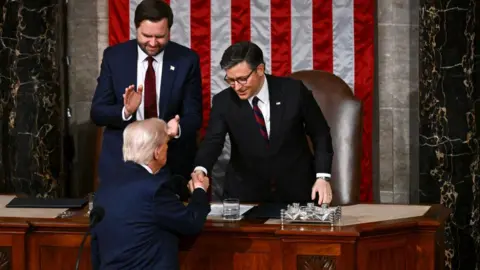
Trump seen shaking hands with Vice-President Vance and Speaker of the House Johnson during his March 2025 speech to Congress
Tuesday's speech is Trump's one and only chance to make his case to the US public before those elections in a major set-piece event before an audience of millions.
On Monday, he previewed what he hopes to accomplish with the address. "We have a country that's now doing well, we have the greatest economy we've ever had and the most activity we've ever had," Trump said. "It is going to be a long speech, because we have so much to talk about."
According to Robert Rowland, a professor at the University of Kansas who has written a book analysing Trump's rhetoric, it is standard fare for Trump to boast about his accomplishments, leavened with attacks on his perceived enemies and critics.
His past speeches to Congress including last year's, which stretched for nearly two hours, have followed a similar pattern. But at what he called a "critical moment" for the president, Rowland said a typical Trump speech may not be the best approach.
"State of the Union addresses are normally a time when the president does two things that President Trump essentially never does," Rowland said. "The president makes a case for his agenda. And they try to broaden the appeal of the agenda of the administration."
Much of Trump's second-term agenda, and his efforts to tout it, have been directed at his political base. Broadening his appeal can at times feel like less of a priority than going on the attack. The political reality, however, suggests the president has some work to do in selling his agenda before November's elections.
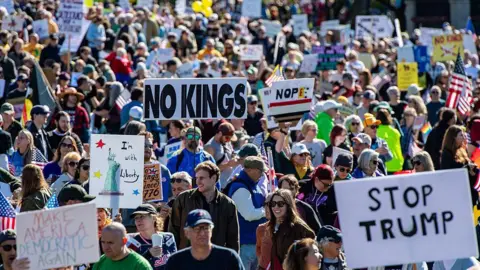
His decision to surge federal immigration agents to cities like Minneapolis may have been popular with the party faithful who waved "mass deportations now!" signs at the 2024 Republican National Convention, but polls indicate many Americans believe he has gone too far.
 Getty Images
'No Kings' protests against Trump were held across the US last year
The president's trade policies, including high tariffs on some of America's biggest partners, have also proven to be stubbornly unpopular. Last Friday, the US Supreme Court ruled that many of the president's duties were illegal, casting the administration's trade regime in doubt.
The president has since imposed new tariffs and pledged to be even more expansive in their use, but the end result is continued uncertainty around the impact that the president's actions will have on the US economy and consumer prices.
While there has been some good news for Trump on the economy, with the stock indexes near record highs and unemployment low, the latest figures on economic growth were below expectations.
The economy and immigration had traditionally been two areas where Trump had the most public support. But his standing on those issues has declined since he returned to the White House, contributing to his sinking overall approval levels.
The recent violence in Minneapolis prompted mass protests and, ultimately, a decision by the administration to reduce the surge of federal agents there with Trump promising a "softer touch".
The administration's efforts to construct or purchase massive new detention facilities has been meet with local resistance. Congressional Democrats have blocked funding for the Department of Homeland Security unless new legal guardrails on immigration enforcement are enacted. That standoff shows no signs of ending.
Last year, the White House hinted that the president was preparing to tour the nation, touting his economic record and offering an agenda that would address public concerns about the cost of living and "affordability" - concerns Democrats capitalised on in last year's state elections.
The affordability tour has only happened in fits and starts, however, and the president has not always stuck to the script.
Policy proposals, like capping credit card interest rates, boosting the housing supply and issuing "tariff refund" cheques, have seen little progress. Although inflation is down from the peak during the first half of the Joe Biden presidency, Americans have yet to see the lower prices Trump repeatedly promised on the 2024 campaign trail.
Ros Atkins on...How popular is President Trump?
On Tuesday night, Trump could try to shift those perceptions.
He could also make the case for why the US is amassing military forces for a possible strike on Iran - a foreign policy twist that could upend American politics in unpredictable ways.
At the very least, Trump's speech could give an indication of how he and his fellow Republicans plan to go about convincing Americans to stick with them when they head to the polls later this year.
"Normally, when presidents realise they are angering the public, they pull back and have some kind of mea culpa," Rowland said. "That's not something that President Trump ever does. I expect him to double down on the messages."
To do otherwise may require a trait Trump has been reluctant to display throughout his time in politics - humility.

Follow the twists and turns of Trump's second term with North America correspondent Anthony Zurcher's weekly US Politics Unspun newsletter. Readers in the UK can sign up here. Those outside the UK can sign up here.