.png)
 1 month ago
60
1 month ago
60
Former WNBA All-Star turned Boston Celtics executive Allison Feaster was recently asked about the differences between high-level female and male hoopers.
“This is a very basic example,” the Celtics’ vice-president of team operations and organizational growth told the Far From the Tree podcast. “But most of the women have had exposure to different types of leadership. Most of the professionals have four-year degrees and even advanced degrees. Many of the professional women have lived outside of the US. Some of them are parents who are the primary caregiver. That is a very general observation, but I venture to say that’s not the same with the NBA players.”
Feaster should know. In addition to setting several Ivy League records that still stand and helping No 16 seed Harvard stun No 1 Stanford in the 1998 NCAA Tournament, she earned a degree in economics. She also spent more than 10 years playing professionally in the WNBA and throughout Europe. It was during a stint in Spain that Feaster gave birth to Sarah Strong, now arguably the top player in women’s college basketball.
Still only a sophomore, the 6ft 2in UConn forward is chasing her second championship in as many years. This time, it’s with an undefeated squad that hasn’t lost in 52 games dating back to last year. As a freshman, Strong thrived defensively in the 2025 NCAA tournament, while scoring the most points by a freshman in tournament history with 114.
In her second season, Strong has been even more dominant. Her impact on both sides of the ball is so deep that she was named the Big East Player of the Year and the Big East Defensive Player of the Year. She’s the favorite to win the National Player of the Year award next month.
This season Strong averaged 18.4 points, 7.5 rebounds, 4.1 assists and 3.3 steals all while shooting 60.0% from the field.
“What makes her unique is her ability to play like a guard and play like a big guy,” UConn coach Geno Auriemma said. “There are players who can get 20 points a game and get 20 rebounds a game but I’m not sure there’s a player other than Sarah who can do both.”
Unlike the last collegiate women’s player with this much jump-off-the-page talent, Caitlin Clark, there is nothing flashy about Strong. Where Clark played with swagger, Strong plays with certainty. And unlike teammate and fellow first-team All-American selection Azzi Fudd, she isn’t a fashionista with her own slogan (“Fudd Around and Find Out”). Strong’s media commitments are certainly increasing (she just appeared on Good Morning America), but the lengths of her answers are not. Strong typically gives one-sentence responses, maybe two. She’s probably not gunning for a cameo on Saturday Night Live any time soon. It’s clear she’s more comfortable letting her game do the talking. Also, she’s only 20.
Her presence, while rooted in poise, calm and an off-the-charts IQ, has produced results impossible to ignore.
So much of the grace she exhibits and respect for the game were instilled by her parents. As if Feaster’s DNA wasn’t enough, her father happens to be Danny Strong, the former North Carolina State forward who played 15 years in Europe. Because of their varied basketball commitments, Strong’s parents, who were high school sweethearts, didn’t live together in Europe and have since split. Strong lived with Feaster, who had reservations raising her daughter in a foreign land away from family as she pursued an unstable career.
Not to mention the risk of later having a language barrier. Catalan was the primary language spoken at one of Strong’s early schools in Spain. Basketball was the primary language spoken at home.
“We would play in the morning, and they would have a game at night and [I remember] just being there the whole day and watching them practice and trying to do the drills they were doing,” Strong told ESPN in 2024.
Eventually Strong excelled at those drills. But upon moving to the States, she didn’t immediately excel in school. She was behind in all things English, and her mother felt guilty.
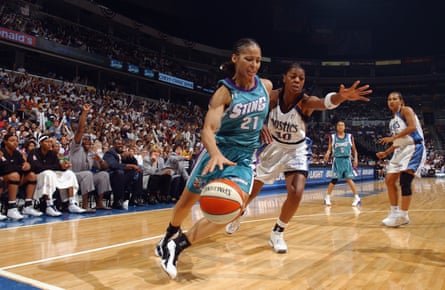
The detail-oriented Feaster quickly noticed her daughter’s struggles with grammar and handwriting. So Strong moved to a school with smaller classes and more attention. And thanks to all that early experience adapting to new locales in Europe, she was equipped with the tools to thrive in new situations.
In North Carolina, where the family moved after Feaster’s playing career ended, Strong embraced the youth basketball scene. She had the benefit of two elite coaches by her side, even once Feaster joined the Celtics in 2019.
Despite the heavy dose of basketball, Strong’s parents made a concerted effort to keep her well-rounded, even signing her for club soccer to mix the activities. Feaster readily accepts that basketball is common denominator which she has utilized for family values. “We tried to emphasize the importance of family time and silliness,” she said. “Basketball is the thing that allows us to be together, but the sport is just the side dish.”
UConn assistant Jamelle Elliott quietly scouted Strong in ninth grade before the hype arrived and she became the country’s top recruit. Auriemma agreed with Elliott’s assessment.
“All you saw was this young kid who had a knack for doing the things that people have to learn to do - and she already had them,” he said. “The way she saw the floor, how she finished around the basket, her non-rushed, casual approach to the game where all the great players have the ability to slow the game down somewhat.”
Meanwhile, Strong, who would play most of her high school career at Grace Christian School in Sanford, North Carolina, focused on having fun with her friends and not getting wrapped up in the recruiting web. “I didn’t compare myself to other players until getting toward the end of high school,” Strong said.
Auriemma, who compares players for a living, only became more enamored with Strong as she developed.
“During her junior year, it became, ‘If we get Sarah to come into our program, we will significantly change the trajectory of our program,’” he said.
Wait a minute: this is UConn. To say one player can change the trajectory of a program that has reached 24 Final Fours and won 12 national championships? That’d be the highest compliment. When Strong committed to UConn in 2024, it was clear the admiration was mutual.
“Everyone gets better here,” Strong said.
The storied names hailing for Storrs – including Diana Taurasi, Sue Bird, Maya Moore, Swin Cash, Rebecca Lobo, and Breanna Stewart - are basketball royalty. UConn has produced more WNBA players than any school. Six players, including Paige Bueckers in the most recent draft, have been selected No 1 overall. And Taurasi, the 2004 top pick, thinks Strong could be the best of them all.
“She’s so smooth out there that one piece that’s overlooked her grit and desire to win. She will do anything to win. She’s the nicest kid,” Taurasi told Yahoo Sports.
Strong’s star is growing rapidly. She’s already inked NIL deals with Jordan Brand, Unrivaled and Madison Reed. She had 18 points in each game as UConn rolled to first- and second-round wins last week, setting up Friday’s Sweet 16 matchup with North Carolina.
Who knows what could be next if she leads UConn to back-to-back championships. Or maybe even a three-peat – the WNBA’s rules mean she won’t be draft-eligible until 2028. Maybe she’ll get comfortable on camera and even pop in on SNL some day.
For now, the only certainty is that Strong, overflowing with talent and grounded by the values that shaped her long before the spotlight, is making this basketball superstar thing look awfully easy.