.png)
 3 weeks ago
70
3 weeks ago
70
Sunshine streams into Lewis Moody’s conservatory near Bath as we share a sofa with his dog, Ziggy, who has swapped his usual cheerful bounciness for a peaceful snooze. Moody has already explained how Ziggy licked away the tears rolling down his face, and the face of his wife, Annie, when they told their teenage sons that he has motor neurone disease. And now he says something extraordinary with a certainty that feels far stronger and more enduring than the mid-afternoon sunlight.
“It is a gift and a privilege,” Moody says of the lesson he has gleaned from the terrible diagnosis he received last October. “I’m not sure if privilege is the right word but MND helps you really understand what you love and what makes you happy. So you learn to apply your time in that direction and, invariably, being happy is about doing things that feel purposeful and spending time with the people you love and doing things that help others.”
It was Moody’s 48th birthday on Friday and the former rugby union international, who earned 71 caps and helped England win the World Cup in 2003, talks so calmly and movingly that his old nickname of Mad Dog becomes redundant. The ex-Leicester and Bath flanker has always been one of the most cherished men in rugby but the way in which he accepted the catastrophic news with such clarity and positivity is even more admirable.
Moody still looks a picture of good health and remains as disarming as ever amid the looming threat that, at some unknown point, his world will shrink amid a disease which can leave its victims trapped in silent paralysis. “The present is all that you have,” Moody says as he tries to live in the here and now rather than succumb to regret or foreboding. “I once read a quote that said: ‘Yesterday is dead and tomorrow isn’t born; there is only now.’ When you’re diagnosed with MND it presents you with that understanding. You realise it’s about prioritising the things that are important and, invariably, it’s the people you love.”
Moody ruffles Ziggy’s curly fur and looks up. “It simplifies everything and I’m a simple bloke anyway. Too much information consumes my brain. So after the diagnosis the immediate question was: ‘What’s next?’ Look after the family. What does that mean? Financial security. OK. Sort out the life insurance – done. Then the next part is how and when do I share the news? How do we make sure it has a positive impact?”
Moody knows I have interviewed Doddie Weir and Rob Burrow in the past, and written a book with Lindsey Burrow about the ravaging impact of MND, and it helps that I’ve seen the worst of the condition as well as the inspirational spirit of those families who celebrate life over an inexplicable medical calamity. I interviewed Weir when it was a struggle for him to talk, and spent a lot of time in the Burrow family home during the final six months of Rob’s life, and it is striking to see how well Moody looks.
He has just returned from a family break in Cyprus, which included watching his eldest son, Dylan, play in goal for England Under-18s. Moody looks tanned and fit and he has bought us some cake to munch during our interview. He still goes to the gym but, as weight loss is a regular side-effect of MND, he is being encouraged to eat as much as possible. And, so far, the disease has had a minimal impact.
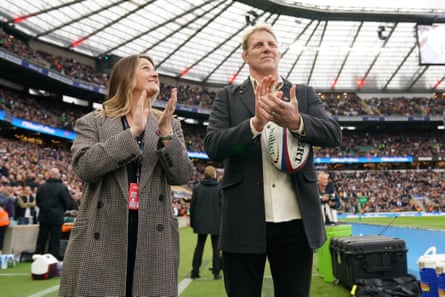
“My finger strength is slightly diminished,” Moody says, “but otherwise, hopefully, there is nothing else at the moment. I can still do everything. It’s just a case of managing energy because, if you get depleted, it drops away quickly. I have to sleep more regularly and listen to my body but, touch wood, the disease is moving slowly.”
Moody discovered he had MND after a persistent but mild weakness in his left shoulder could not be resolved by a physiotherapist who sent him to a specialist. A battery of tests included “two nerve conduction studies related to motor neurone disease”.
Moody shakes his head when asked if he was shocked at that first mention of MND. “If you Google weakness in the shoulder, grip and circulation, it throws up MND. When I asked the doctor for the worst-case scenario he said: ‘Well, I can’t rule out motor neurone disease.’ From that point you’re waiting for your next appointment and these two conduction studies. They were the worst two weeks by far.”
Lindsey Burrow told me that, when she and Rob heard that he had MND, it was like a bomb went off inside her. “It was different for me,” Moody says, “because I’d prepared myself. I spoke to Annie and three mates, including Geordan [Murphy] and Leon [Lloyd] who are my two closest friends from rugby.”
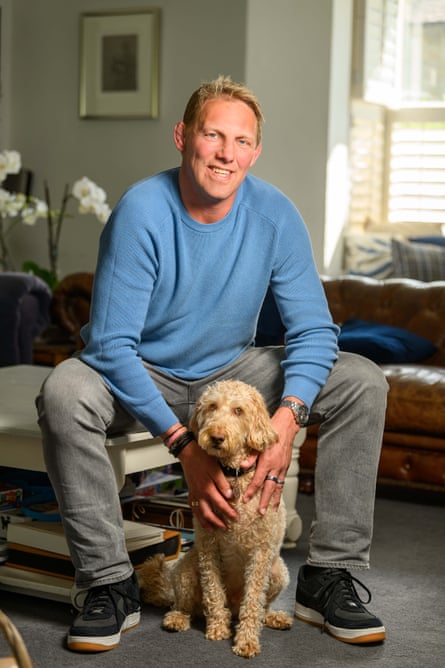
Moody’s eyes are clear as, quietly, he says: “I cried then because in my head I’d almost told myself it was MND. So when the specialist confirmed it I didn’t feel surprised. But it was still horrible. Annie was incredibly emotional, as you can imagine, and she and the doctor found it difficult. We left in a haze.”
Was Moody offered a prognosis of life expectancy? “No, but they give you these statistics which are obviously not what you want to hear as 10% [of people diagnosed with MND] don’t last a year; 50% don’t last two years. But that means 40% survive longer than that. Think of Stephen Hawking [who lived and worked with MND for 55 years]. I know people living with it now, 12 years in. I know a guy who’s six years in and he’s still only got hand symptoms. Everyone is unique.”
Moody pauses as reality bites again. “It is harsh and, if it’s fast, it’s particularly cruel. So the only certainty in MND is that it’s uncertain – which is really hard.”
I ask Moody about the difficulty of telling his sons. “Dylan had heard of MND but my youngest just wailed in an emotional outburst. Ethan didn’t understand and he and his brother are very different. But once Ethan calmed down he said: ‘I want to know. Tell me everything.’ We shared that it’s a life-limiting condition but stressed that everyone’s different. It doesn’t mean that the statistics around MND will apply to me. So the more information we gave him, the more he could process it rationally.
“It’s the same for me. The more information I had, the easier it got. It still fucking hit me but I can process my emotions quite quickly. Of course they creep up, like grief, when you least expect it but it’s hardest when other people are upset and it’s your mum, your kids or Annie.”
Moody’s face soon lights up as he remembers how they celebrated Dylan’s 18th birthday in March. “It was wicked. His mates and my mates playing stupid drinking games and being silly. It was like being 18 again myself.”
His boys will join Moody and his friends on Sunday, as they cycle from Newcastle to Twickenham over five days to raise money for Doddie Weir’s foundation, which helps fund research into developing effective treatments and finding a cure for MND. They aim to reach £777,777 in honour of the number Moody wore as an openside flanker; but there will also be the simple pleasure of riding across the country with great friends and former teammates such as Martin Johnson, Jonny Wilkinson, Jason Robinson and Julian White.
“Julian’s never ridden a bike that hasn’t got tractor tyres on it,” Moody says of the former Leicester and England prop forward who is now a farmer. “We’re starting in Newcastle which was Doddie’s home club. We’ll have his wife Kathy and his son Hamish with us which is really cool. We met them at a dinner we had in December and Hamish, who connected so well with my boys, is hilarious.”
Moody faces a 500-mile bike ride and I ask if his weakened hand will cope with the pressure of holding the handlebars. “It’s great at the minute. The only thing I’ve noticed is fatigue in the shoulders so I’ve had to adjust the handlebars and seat so there’s more weight on my arse than in my arms. It’s a big arse, so it’s fine.”
More seriously, Moody adds: “The advice is avoid over-exerting yourself. So a good outcome for me is just getting through it. It’s not about doing it all if I can’t. But this is an opportunity to spend time with lads I’ve not seen for years. We spent the best part of a decade together, and came through some of the toughest scrapes and some of the stupidest nights out.”
Moody was a fearless competitor who suffered multiple concussions and ferocious hits – but he refuses to blame rugby. “I loved rugby and I knew there were risks running into people with your head and getting concussed repeatedly. I can’t look back now and go: ‘I wish I’d changed that.’ But the advancements in concussion protocols are wonderful.”
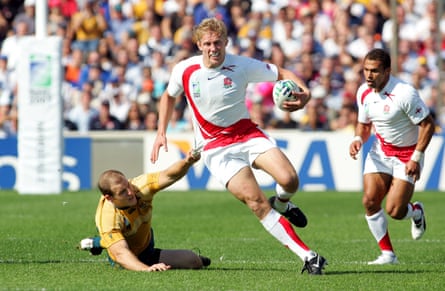
Rugby is far safer now and Moody totally supports his youngest son playing the game. He also points out that “the process is multifaceted and there’s not ever one thing that causes MND. It’s a multiple combination of factors and more research needs to be done.”
That urgent need for research drives Moody now: “Remember Doddie’s legendary quote when he got the scientists and MND researchers around the table and the chief dude says: ‘I’ve been working on this for 25 years blah blah.’ And Doddie’s like: ‘What the fuck have you been doing?’ Typical Doddie – hitting the nail on the head.
“I feel lucky I’ve arrived in a more hopeful place because of the people who came before me. I had this conversation with Kenny Logan [the former Scotland international] and said: ‘Mate, I feel like I’ve been given this baton by your boys, by Doddie, by Rob, by Ed Slater, and I need to get this over the line.’
“There is so much hope now. The specialists say it quietly because they don’t want to get too excited. But they are talking about a cure and, actually, they feel it’s round the corner. MND is not incurable; it’s just underfunded.”
Has Moody changed since his diagnosis? “Oh, it’s a good question. Have I changed? No, I don’t think so. How I view things has changed but I’m just more focused, clearer, engaged and ready to get a better version of myself.”
The afternoon stretches ahead of us and Moody allows himself to step outside the moment to reflect more deeply. “The times in my life where I felt really alive was when I felt the greatest adversity. For me, there’s probably no greater adversity than what I’m facing now. But so many people are doing amazing things in the MND space all the time. Many of them have no platform and don’t get attention. But I get the opportunity to help those individuals – and I want to impact that space with real purpose for all of us living with MND.”
The Lewis Moody XV Cycle Challenge Supports My Name’5 Doddie Foundation. To donate please visit https://lewismoodyxv-cyclechallenge.com/. For more information visit https://www.myname5doddie.co.uk/