.png)
 1 month ago
67
1 month ago
67
Roussillon is a small town nestled in the Rhône valley, about 40 minutes south of Lyon by car, and a reminder that the most extraordinary stories can hide in the most ordinary of places. One player says “the town doesn’t ‘live’ for [its] club”, but as you head through the town centre and towards Salaise Rhodia’s stadium, you begin to doubt whether the town lives at all; welcome to a Sunday in rural France.
Around 30 minutes before the start of the game, the single stand begins to fill. Everyone seems to know each other in some way. Entry is free for what is a top of the table encounter in the Régional 2, the seventh tier of French football, against Craponne AS.
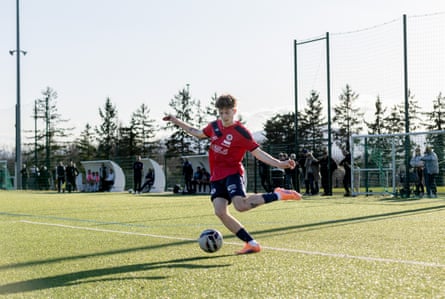
Behind the goal are a smattering of ultras. Their duties consist mainly of taunting the opposition goalkeeper, intimidating the referee and teasing their star player, Titouan Richard. “I’m their little favourite,” he says with a smile.
Richard also happens to be two games away from playing in the World Cup. His story is not dissimilar to several others hidden within inconspicuous lower-tier grounds dotted around the French mainland.
New Caledonia, 150th in the Fifa rankings, head to Guadalajara this week hoping to book their place at the World Cup. To do so, they must overcome Jamaica and then beat DR Congo.
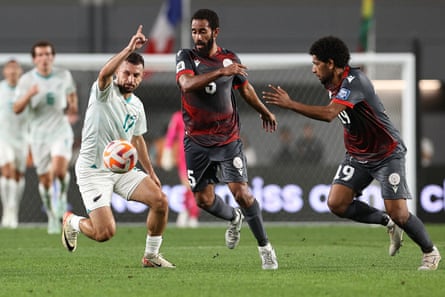
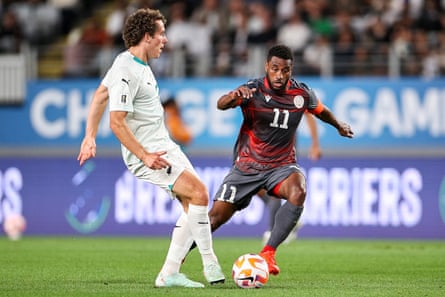
It would be a first for the French territory, whose opportunity to qualify can be attributed to the expanded World Cup format, which granted Oceania an automatic qualification place for the first time, filled by New Zealand, as expected. They had to overcome a stubborn New Caledonia last March, winning 3-0, to claim it.
“When we play against New Zealand, they are all professionals,” Richard says. “It’s a different environment.”
While New Zealand’s Chris Wood is playing in the Premier League, Richard has been balancing training and matches with work and studies, at least until recently. Having worked at Intermarché, a French supermarket chain, while taking studies in communication he is now unemployed, but the career is on hold.
“It’s a good thing I don’t have a job at the moment,” he says, joking. He has previously had to take unpaid leave to represent the national team.
“Sometimes [the trips] are a pain, but you have to do it,” says the New Caledonia captain, César Zeoula, one of the few contracted players in the team. He plays in the fifth tier with US Chauvigny.
Players gather in Paris before being flown over by the federation for a 20,000km journey east, but it was making the opposite journey that used to be more difficult. “Back in the day, it was very hard to come to the Métropole because being far from family, with the flight prices, it wasn’t a given. Now it is a lot easier,” Zeoula says.
The federation has encouraged its players to move to the mainland in recent years. The New Caledonia manager, Johann Sidaner, says: “One of the objectives I was set when I joined in August 2022 was to create connections with L’Héxagone, to ensure the boys were playing at a certain level.”
The strategy has taken on greater importance in recent times. “There are events that have weakened football in New Caledonia,” Sidaner says, referencing island‑wide protests in response to a proposed voting reform that forced the suspension of the football league in May 2024. The league resumed normal running this month. “It is true football has faced a setback,” he says.
One of the many challenges Sidaner faces is tracking his players, given the geographical distance and the difficulties in following amateur football. “We brought in an app, Suivi Sport, which we saw as absolutely fundamental. It allows us to follow the boys throughout the year.” Players log their “sporting activity”, as well as their “daily lifestyle and wellbeing”.
“We follow 45 on a daily basis and the idea is that each one has to be ‘in the green’ in order to be selected,” says Sidaner, who, before his appointment by New Caledonia, spent 11 years working with Nantes’s prestigious academy.
With the qualifiers approaching, no one wants to be in the red. Richard says: “The closer it gets, the more it runs through your mind. You tell yourself that, in every session, you have to work a bit more to be ready. It has never happened that a Régional 2 player is two matches away from the World Cup.”
Zeoula, who is 36 years old, says: “These are two elite-level matches that maybe we will never play in our lives again.”
With many of New Caledonia’s players reaching the end of their playing careers, Zeoula says it will be an “emotional moment” as they come together and try to achieve history.
Simply coming together has a galvanising effect. “It’s true that it’s difficult to be all alone, far from your family, uprooted,” Sidaner says. “They can’t necessarily give their full potential, but when they’re together they have a culture here of being more than families. They are clans and entire tribes that are used to working together and when they are together they move mountains.”
Richard says: “We’re telling ourselves that in football anything can happen.” He also talks about needing a bit of luck.
That deserted his side as they slipped to a 3-2 defeat against Craponne, despite a goal and an assist from the New Caledonia international.
Given where they play there is perhaps a tendency to slip towards condescension, but that would be a mistake. New Caledonia finished top of their qualifying group, after all. “If we’re there, it’s because we deserve to be. We’ve already pulled off exploits,” Richard says.
Achieving another would allow New Caledonia to enter a world far removed from the Stade de La Terre Rouge in Roussillon, one where, although the rules of the game are the same, the stakes are stratospherically different.