.png)
 1 month ago
89
1 month ago
89
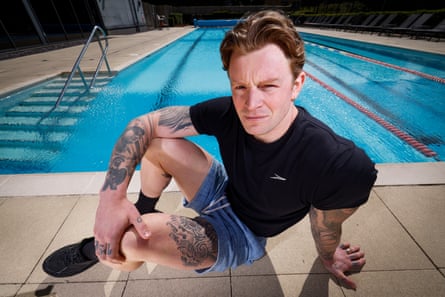
“I couldn’t switch off because it’s been a real rollercoaster of a week,” Adam Ramsay-Peaty says with a weary smile on a quiet Thursday morning in Glasgow. He has just endured a rough night in which, after winning his third medal of the Commonwealth Games, he managed less than three hours of sleep. The medals consist of bronze in the 100m and 50m breaststroke and a silver in the men’s 4x100m medley. For most swimmers this would constitute success and satisfaction, but Ramsay-Peaty is different.
The fact that none of his three medals are gold, or attached to anything remotely like the kind of supreme performance that Ramsay-Peaty churned out with an aura of invincibility for eight years, has taken a chunk out of the double Olympic champion. There have been tears of frustration and an admission that “nothing makes sense this week”.
Ramsay-Peaty also sent out a fiery message to his tormentors in the tabloid press, and on social media, to stress that “you can’t hurt me” before urging an end to the excessive intrusion into his private life: “It has to stop. How many athletes have to go through this until the media learn their lesson?”
Now, in a small room on the outskirts of the city, Ramsay-Peaty admits that “decompressing last night was hard”. The European championships, which begin in Paris on 10 August, will see him gather himself for the next chapter in a tumultuous career, which he hopes will peak at the LA Olympics in 2028.
“I’ve experienced a lot in this sport,” Ramsay-Peaty, now 31 years old, says intently. “I’m never going to stop believing what I can do. I just need to get to that peak once more.”
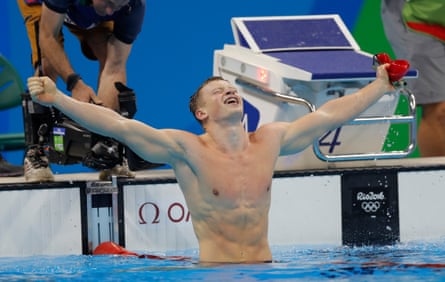
Ramsay‑Peaty did not lose a single race in the 100m breaststroke from 2014 to 2022. Apart from winning three Olympic golds and eight world titles, by 2021 he had swum the 20 fastest times in the history of the discipline – and the 10 fastest in the history of the 50m.
After finally losing a 100m race, in the 2022 Commonwealth Games, Ramsay-Peaty suffered a breakdown a year later, quit swimming and lost himself in a haze of drink and depression. It was an epic feat to drag himself back from the brink and, in the 2024 Olympic final, miss gold by two-hundredths of a second while swimming with an undiagnosed case of Covid.
“After those Commonwealths in Birmingham,” Ramsay-Peaty says of his shock defeat four years ago, “I went on the attack and turned myself into scorched earth. I gave too much and that led to the burnout zone in 2023. I know not to do that now. I’ve got to find that peace and consolidation and realise we couldn’t have done anything more.
“We’ve trained extremely hard. I’ve only been 12 weeks in London with a new coach and a new programme. That takes time to reach fruition. Once you prune the tree, you grow more fruit in the end.”
After losing the 100m last Saturday, having swum almost three seconds slower than his world record, Ramsay-Peaty said: “I’m not crying because it’s a bronze instead of a gold. I’m crying because I know that the swim could have been better, and I worked way better than that.”
Another bronze in the 50m was accepted more philosophically by Ramsay-Peaty: “When I was undefeated for eight years, it was athlete first, then human. Now it’s human first.”
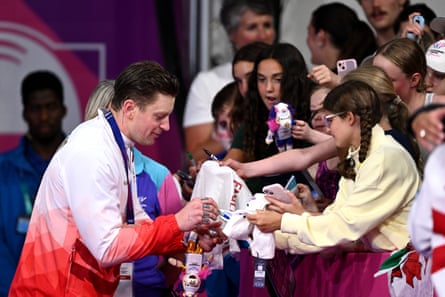
This is a healthy alternative to the raging obsession that once consumed him. “It’s a natural progression from putting absolutely everything into the sport, which came at a huge cost,” he says. “You realise now that if you’re second you’re not going to die. You just have to learn from it. So there is a new approach because to do what I did you have to go to a place of anger, almost a place of hate, and I don’t want to be in that place. It’s a huge emotional cost that isn’t sustainable. I know I can win with a newer mindset and without the dark stuff.”
Ramsay-Peaty remains a fierce competitor and, looking ahead to the Europeans, the old fire crackles: “I’ve still got to burn the boats. I’ve still got to go all in, and believe I can win. If I don’t have that mentality I’m never going to get close. I know the Europeans are going to be fast in the heats. But I’m going to be good.”
After a dozen years at the summit, it sounds as if the more human side of Ramsay-Peaty is winning: “Every athlete has their own version of success. Of course, mine is still tied to quantifiable things like medals and times. But if I enjoy this journey and know I’ve given my best, and I touch that scoreboard in LA, that’s already success. That’s not defeatist. I’m still going to be a warrior. I’m still going to fight and give my absolute best.”
I tell Ramsay-Peaty about a column in which my colleague Barney Ronay compared him and his monumental achievements to other ageing sporting greats such as Lionel Messi. Ramsay-Peaty grins; he watched the 39-year‑old Messi stroll around so many World Cup pitches this summer before bursting into flaming genius when his grinding teammates needed him.
“Team sports have the benefit of being able to carry special players. But as a swimmer, when you’re older, it’s harder to race in the heats, and then the semis and finals. There’s nowhere to hide. When I’m going through that last 25 metres, it’s not like I can pass the ball and say: ‘You take this bit for me.’ Believe me, I probably would. But on the other side, with the success I had when I was younger, I wouldn’t have wanted to be in a team sport because my values and work ethic are so high I don’t think anyone could have kept up.”
Has he made sense yet of what went wrong in Glasgow especially as, a few months ago, he won the nationals in a time that would have clinched gold in the 100m Commonwealth final? “I was probably in a better block of work then, as we have to constantly balance our aerobic and anaerobic capacities. Maybe this past week was one of adaptation and, with a week of rest going into the Euros, I’ll be stronger. I worked the hardest I’ve worked in a very long time these last 12 weeks but maybe it wasn’t enough time for me to adapt. You also have to be race‑fit, and that’s a very different skill set. It still doesn’t make sense but tomorrow we have a debrief with my coach, Lisa Bates.”
Ramsay-Peaty adds: “We overthink a lot in this sport and we can look at all the data variables and rip up what is actually a lot of good work. Sometimes we just have a bad day, and that’s OK. But it’s not OK if it keeps happening.”
Bates replaced the great Mel Marshall, who had coached Ramsay-Peaty for his entire career until the 2024 Olympics. Marshall now works in Australia. “I’ve known Lisa for a long time,” Ramsay-Peaty says, “and Mel’s very close friends with her. It came with the decision to move to London because my wife [Holly] is pregnant so we needed her family. We’re having a little girl in December.”
Holly’s father is Gordon Ramsay, and the combination of a celebrity chef’s family in London and an Olympic champion’s working-class family from Uttoxeter has been catnip for the tabloids. Personal problems between the swimmer and his parents have been the source of feverish gossip and adding his wife’s name since their marriage has fuelled wild speculation.
Has it had a serious impact on him? “I wouldn’t say on me because I’ve got a thick skin. But I care about my wife, I care about my son [from his previous relationship]. I care about the relationships that people think I have with my son, and my own family, but that’s my private life. I have incredible relationships with some people in the media, like the one with you, which is built on trust over time. The ones that don’t go well are with the tabloids selling these stories for advertising. It’s pretty much the downfall of society when we’re exploiting people’s private lives to sell. Will it get better? Probably not. Will the truth come out one day? Absolutely.”
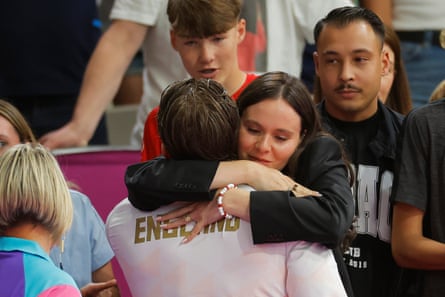
His mother, Caroline, posted a statement on social media this week about the rift. Is he hopeful there can be a reconciliation? “For me, as a Christian, there has to be forgiveness. It doesn’t mean you have to forget, but forgiveness takes time. I’m not saying that it won’t get better but it has to come from a place where I feel like they’ve improved as people, in a sense, and opened that communication up. I haven’t told one thing to the media. I haven’t done one story over the last eight months and more.”
We return to the sense of invincibility that Ramsay-Peaty carried for so many years. I read him a quote that he gave me in 2015, after he had won three gold medals at the world championships. Aged 20, he sounded remarkably mature as he said: “I feel no pressure. I enjoy racing. What’s the worst that could happen? You’re going to come second or lose? It’s not like someone has got a gun to your head.”
Eleven years on, he says : “There’s a part of me which screams that you want that risk [of hating defeat]. That’s the athlete. The human knows that isn’t the right path. That isn’t going to make me the best husband, the best father, the best friend. That athlete is incredibly selfish, and will ruin any form of relationship. I guarantee that because I’ve been there. But I still haven’t found that healthy medium.
“In training I don’t struggle one bit with that [athlete’s] mentality. I can switch it off when I leave training. It’s more about the exhaustion of training twice a day, going for it every single day. It’s now about finding what is optimal and sustainable in LA.”
If Ramsay-Peaty is preparing for the 100m he needs to swim around 9,000m on a training day. But if he concentrates purely on the 50m it would be “way less, probably 3,000m a day. You’d only have to do 12k a week, but I’m doing 40k for an extra 50 metres.”
Is he thinking of giving up the 100m and aiming only for the 50? “Not yet, no. I know I can be so strong in the 100. We’ve got to keep it in perspective. This is my first championships in two years. It’s been a bad week and we need to be better.”
Does he believe he will finally unearth the elusive balance of compulsion and decency and, in 2028, complete his journey in the most meaningful way, whatever the colour of any medals he might win?
Ramsay-Peaty pauses and then his face cracks open in a big, gleaming smile: “Yes. I’ve got a good armoury. I’ve just to get the polishing cloth out now.”