.png)
 1 month ago
69
1 month ago
69
With two games of the 2005 season remaining Nottinghamshire, under the captaincy of Stephen Fleming, were sitting precariously at the top of the County Championship, still needing to visit their two main rivals. First up was Kent: Notts were 397 for five after the first day, but rain washed out most of the second and at the end of the third Kent were only five down. A draw looked inevitable, and with a Shane Warne-inspired Hampshire – Notts’ final opponents – on their way to victory at Glamorgan the title chase seemed to be turning. But Fleming had other plans.
“He called a meeting of the senior players on the fourth morning to say he had an idea,” says Darren Bicknell, his Notts teammate. “If Kent didn’t win the game against us, they were dead, they’d have no way to win the title, so he recognised that he had them over a barrel a little bit.” Fleming offered Kent the chance to chase 420 in 70 overs, an unlikely target – but also the best they were going to get. “To take a calculated gamble in that game was a stroke of genius,” Bicknell says. “Some of the senior players were a bit anxious, thinking we didn’t need to take any risks because the draw was still a good result. But people went with him.”
On that final day Kent duly declared their first innings; Notts motored at seven an over until the agreed total was reached then declared also; then Kent, with no choice but to attack, were bowled out for 205. Notts won the title with a game to spare.
England’s interim captain when New Zealand played them the previous year – Marcus Trescothick, now back in charge of England’s Test side in an interim role – had admitted his opposite number was “regarded as the best captain in the world”, and here was more proof. Kent’s first man out in that forlorn run chase? Rob Key, the man who has just appointed him England coach.
“He was just very calm all the time, very unruffled,” Bicknell says of Fleming. “He worked out the game really well, worked out people very well, but overall he was just calm, even in the hottest of moments. Everyone trusted him to be on everything. I think in moments when things weren’t going well, there was a reflection from him that everything was still all right: just be patient, stay calm, and it will come right as long as we’re doing the right things. He was just a really good man and the sort of person you felt like you wanted to play for. I think he’ll be very good and he’ll bring a sense of common sense and calmness to the whole England set-up.”
Fleming has not always been calm in hot moments. There is another widely quoted example of his cricketing cunning: in the fifth of six ODIs in South Africa in 2004 the hosts, needing to win to keep the series alive, came out to chase an achievable, rain-affected target of 178 in 29 overs. As their captain, Graeme Smith, approached the crease Fleming unleashed a stream of invective.
Just three days earlier Smith had described Fleming “changing his game plan against me in every match so far … I’m sure he’s just trying to get into my mind”. But as this normally gentle man showered him in abuse, that was all forgotten. Smith responded in kind and then, distracted, scored 15 off 33; New Zealand won by two runs. “Graeme is an emotional guy. That was one chink we thought we might explore and he took the bait,” Fleming later said. “It was never personal. I made it personal in one game to get the edge.”
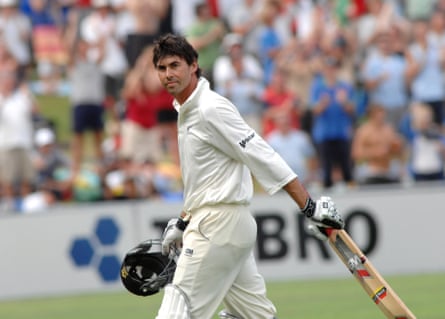
Those who have worked with Fleming describe an empathetic man, a skilled reader of people – skills he can use to build you up, but perhaps also to destroy you. “He was quite simply an outstanding leader of men,” says David Alleyne, another member of that Nottinghamshire side. “He had a great way of communicating, and finding the right time and the right space to really empower you as an individual, and get you to think about your game in a way that was going to help the team. I found him quite remarkable in that sense. He was very calm, very calculated.”
after newsletter promotion
Praise for Fleming has not quite been universal, and most notably Hemang Badani, currently head coach of Delhi Capitals and Southern Brave, said the success he achieved at Chennai Super Kings in the Indian Premier League – where he reached 10 finals and won five titles – was all down to his long-time captain, MS Dhoni. “He’s never won anywhere outside the IPL,” Badani said in 2024. “If someone says he’s a great coach, I wouldn’t agree. Dhoni is the winner.”
Chris Jordan, having played under Fleming at CSK and Southern Brave, disagrees. “He comes with a lot of empathy. He has a very relaxed aura about him but he’s still very, very detailed in his planning and his messaging. And he’s very, very good at creating role clarity within a team,” Jordan says. “One thing he identified about the Hundred, he was astute enough to realise that it can be quite chaotic. So he found a way of getting us to find simplicity within the chaos, just with his messaging and his tactical awareness. He’s just a very well-rounded coach, and when you start to spend time with him you really get the feeling that you not only want to do well for yourself, but you want to do it for him as well.”
Jordan is one of just a handful of people to have played under Fleming and alongside Joe Root, who has returned as England captain. “I definitely think Joe and Flem as a combination will be quite excellent, and I actually think Flem could take Joe Root’s captaincy to the next level,” Jordan says. “He really has that knack of bringing out the best in players and making you really believe in yourself. He’s just a top human being.”