.png)
 4 weeks ago
80
4 weeks ago
80
Even the Nazis tried to tone things down a bit. Before the 1936 Olympics in Berlin, acutely conscious of how it might be perceived by foreign visitors, the Third Reich tried to soften some of its harder, more intolerant edges. Antisemitic signs and images were removed from shops and other public places. Der Stürmer was removed from newspaper kiosks. Paragraph 175, the country’s strict anti‑homosexuality law, was temporarily suspended.
By contrast, the 2026 men’s World Cup is being co-hosted in a country utterly indifferent to what a foreign visitor might think of it. In this respect, the US of Donald Trump is tonally different to any host of a major sporting event that has preceded it: a country that actively wants you to see the darkness in its heart, the inhumanity at its core, that gets off on your revulsion.
We can assume, for example, that the administration knew exactly what it was doing when it turned away Omar Abdulkadir Artan at its borders just days before the tournament. After all, Artan is from Somalia, one of the many countries about which Trump has made his views entirely clear, previously describing Somalis as “garbage” and “crooks”. “We want to make sure we are not going to allow a soccer tournament to be the opportunity for terrorists to potentially get in the country,” said Andrew Giuliani, head of the White House World Cup task force.
On one level you had to marvel at the levels of cartoon evil necessary to unite the rest of the world in sympathy for – of all people – a referee. But of course this was simply one scene in the World Cup’s theatre of performative cruelty. The vice-captain of Iraq was detained for seven hours on arrival. Thirteen members of the Iranian delegation are still waiting for visas, and their allocation of fan tickets has been revoked. According to the BBC, 11 of the 48 participating countries – all of them from the global south – are facing travel restrictions or unusually high rates of visa rejections.
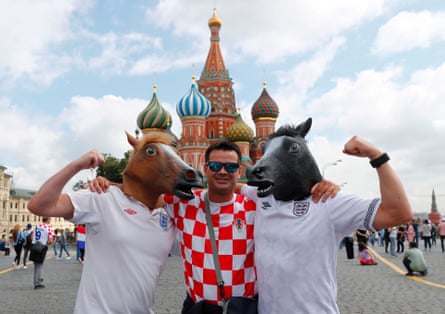
What of Fifa, the organisation that appointed and accredited Artan for its tournament, which boasted last summer that “everyone will be welcome”? After all, the sport’s governing body has rarely been shy of using its leverage over past host countries. In 2014 it threatened to strip the Brazilian city of Curitiba of hosting rights after construction of its stadium fell behind schedule. In 2018 it successfully persuaded Russia to relax its stringent immigration laws to allow fans visa-free entry, and even intervened to overturn a ban on the German investigative journalist Hajo Seppelt. “Freedom of the press is very important to Fifa,” it said, one of many Fifa statements over the years that has not aged well.
Fifa was able to do these things because to a large extent it was dealing with countries who were seeking to project themselves: desperate for the soft power, the validation, the tourism revenue. On some level, every men’s World Cup host since 2010 has needed Fifa more than Fifa needed it.
The US may be the first ever host country where this traditional balance of power has been reversed. It doesn’t need the money; indeed, for all the gouging of ticket and transport prices, it is barely going to make any. According to a Saxo Bank report, the anticipated benefit will be less than 0.1% of GDP, and “is not a meaningful growth driver”.
But, of course, Fifa definitely does need the money. Unlocking the dynamic revenue streams of the US sporting economy is Gianni Infantino’s best chance of maintaining the revenue growth that buttresses his power base. By way of illustration, the 2030 World Cup – to be held in Spain, Portugal, Morocco, Argentina, Uruguay and Paraguay – is already forecast to generate higher costs and lower ticket revenue, with the shortfall to be made up from an uplift in marketing revenue and broadcast rights.
With the World Cup now expanded to 48 teams, there is a rapidly dwindling pool of countries with the size, the means and the infrastructure capable of hosting. In essence, Fifa now needs the US far more than the US needs Fifa, which has had a direct effect on the indignities and inconveniences it has been prepared to swallow. Will it raise its voice if immigration raids take place at stadiums? What if the nextRenée Good or Alex Pretti fancies protesting somewhere near a World Cup venue?
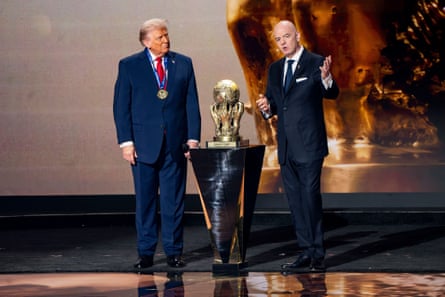
In reality, Fifa has already articulated its worldview most eloquently. Indeed in continuing to parrot the phrase “football unites the world” like a malfunctioning pull-string doll, Infantino is tacitly expressing his opinion that there are people he simply does not consider part of the world, perhaps does not even consider human at all. And so to the jailed dissidents of Russia and the nameless migrant workers of Qatar we can add the imagined enemies of the Trump White House: whether Senegalese football supporters or reporters asking questions or a referee from Somalia embarking on the greatest honour of his professional life.
The only meaningful solution – a smaller and more modest World Cup, less beholden to autocratic power, more accountable to its public – is also the only solution that can be safely ruled out. Instead, the power imbalance of this World Cup may well end up setting a template for subsequent sporting events to follow. Rest assured, Saudi Arabia 2034 will have noted Fifa’s prostration here, its utter spinelessness in the face of hard autocratic power and urgent commercial imperative.
For a generation Fifa has enthusiastically participated in what the academic Martin Müller described as “event seizure”, the way in which big sporting events take possession of their host cities and societies, rewrite local laws, empty local budgets. Here, the opposite appears to have occurred. The World Cup has not seized control of the US. Instead the US has seized control of the World Cup, taken this cherished global heirloom and turned the whole thing a shade of puce Maga.
Perhaps none of this moves you unduly. Perhaps you still regard sporting spectacle as your cherished escape from politics. In which case enjoy your World Cup of games split into four quarters, decimated by heat and exhaustion, compromised by an unfair qualification process. Enjoy your largely meaningless group stage, the thousands of empty seats, the masked police standing guard just at the edge of shot, the long lingering shots of Infantino and JD Vance in the stands.
Infantino is, of course, the symptom rather than the disease here. And yet, given his own self-image as a kind of messianic pan-global statesman, there is a certain irony in the fact that this summer will cement his legacy as one of sport’s greatest cowards: a weak and petty man who lost control of his own tournament. A man who quivered in the face of genuine conviction. A man who had the world’s most powerful cultural force in his hands, and ended up giving it away.