.png)
 1 month ago
111
1 month ago
111
Spain is at it again.
A year ago Rafael Jodar, the teenage sensation from Madrid, was ranked around No 700 in the world and completing his freshman year at the University of Virginia. After winning several ATP Challenger titles (the level below regular ATP tournaments) the Spaniard decided to turn pro and forgo his final three years of college eligibility. Jodar won his first main-level ATP match at this year’s Australian Open. And now, stunningly, after a meteoric and nearly unprecedented rise up the rankings, the 19-year-old will be among the 32 seeds when the French Open commences Sunday.
And, in the process, the “new Rafa” – while he has said he was inspired as a child by Nadal, Jodar is named after his father and grandfather – has managed to steal the mantle of the “next future champion” hype away from Brazilian João Fonseca. Ironically Fonseca, also 19, was committed to play college tennis at Virginia with Jodar but instead decided to turn pro, leaving one to wonder if that college team, had it materialized, would have been among the best ever.
To have yet another player thrust into the grand slam-winning-possibility conversation adds to the utter embarrassment of riches Spain has enjoyed for more than three decades. Starting with Sergi Bruguera’s back-to-back French Open titles in 1993 and 1994, the Spanish men have enjoyed a nearly uninterrupted run of dominance with six different players winning grand slams, culminating – at least, one assumed it was culminating – with Rafael Nadal’s 22 major titles. Consider: just three months after Nadal’s final grand slam triumph at the 2022 French Open, Carlos Alcaraz won his first major championship at that year’s US Open. (He has since won six more, but will miss this year’s French Open and Wimbledon with a wrist injury.)
The only Open-era analog that comes to mind is Sweden’s moment in the sport in the 1970s and 80s. Björn Borg, the ultimate tennis icon, put Sweden on the map with 11 grand slam titles in an eight-year span, starting in 1974. After he vanished from the sport following his excruciating defeat to John McEnroe at the 1981 US Open, Mats Wilander took up the cause and won the 1982 French Open, his first of seven grand slams. Stefan Edberg then grabbed six majors between 1985 and 1992. Sweden’s time in the tennis sun also merged with the sudden cultural influence from the Scandinavian country, from Abba’s music to Saab’s turbo cars.
With his ferocious hitting and aggressive posture constructing points, Jodar continues to put a nail in the coffin of the notion that Spanish players are primarily clay-court specialists. Nadal was unfairly burdened with the “he’s great but only on clay” label very early, but his Wimbledon triumph in 2008 proved he could play; Alcaraz burst on to the scene as a fully formed all-court player.
So how did Spain become such a powerhouse in the men’s game? Many trace the origin story back to the early 1970s. The country’s dictator Francisco Franco, inspired by Manolo Santana, the first Spaniard to win a grand slam, ordered the construction of thousands of red clay courts throughout Spain, literally building the infrastructure that laid the groundwork for what was to come.
Though it took a generation, the coaching techniques and training regimens put in place 50 years ago in Spain have now become standard practice for players from around the world.
The two coaches who were the most instrumental in developing the Spanish brand of men’s tennis in the 1980s and early 1990s were Pato Alvarez (now deceased), and Lluis Bruguera (the father of the aforementioned Sergi), who is in his 80s and still coaching.
Both based in Barcelona, they developed a style of coaching that Chris Lewit, author of the book The Secrets of Spanish Tennis, narrowed down to six tenets: movement, footwork and balance; racket speed and weapon building; consistency; defense; physical conditioning; and, finally, the importance of suffering.
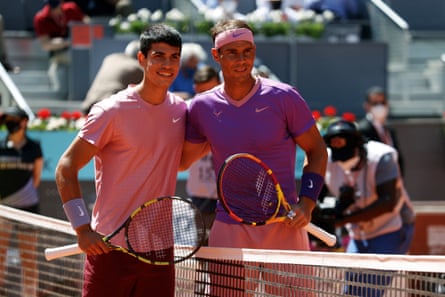
It is this act of suffering, of fighting through and retaining a positive mental outlook in the midst of the mini-crises that exist in every match, that is the most significant throughline among all the recent Spanish champions. Nadal famously said that “you have to learn how to live with these kind of moments, and also to enjoy this suffering”. Alcaraz echoed that with his view that “you have to find the joy in suffering”. While Nadal was coached at home in Mallorca with his Uncle Toni and Alcaraz in an academy setting under his former coach Juan Carlos Ferrero, the hallmarks of Spanish tennis seamlessly moved from one generation to the next. This focus on the “suffering” and on the point construction has allowed the transition away from the clay-only successes of Bruguera to the all-court prowess that Alcaraz and now Jodar possess.
It is this generational hand-off of not just the physical attributes and strategies necessary for triumph but the mental fortitude that is apparent with Jodar. Speaking of Nadal, Jodar said, “He was, I think, the best mentality wise. He never gave up in a match. He stayed there for every moment that the match was bringing him and tried to play his best tennis with the things he was doing throughout those days. I think watching him inspired me when I was younger.” Additionally, Jodar, like Nadal and Alcaraz before him, plays the game with a supreme confidence, grounded in an oft-articulated humility that keeps the best players hungry.
If the Spanish method has been such an incredible success then why haven’t more countries followed their lead? Many countries and players already have tried. A teenaged Andy Murray became so inspired by the Spanish style that he spent significant time training in Barcelona under the tutelage of Alvarez, and he has spoken of how huge an impact those years in Spain had on his development into a three-time grand slam champion.
Jose Higueras, a former Spanish pro who was one of the first players to emerge under the new Spanish system in the 1970s, imported much of the program to the United States when he started working with US pros in the 1990s. He wanted to bring that clay-court attitude to the American style of play, which was usually focused on a big serve and forehand. And it yielded immediate results. Higueras coached Michael Chang to his sole grand slam title at the 1989 French Open and then worked with Jim Courier as the coach played a pivotal role in the last golden era of American tennis.
One can implement all the correct protocols and latest methods, but it’s all for naught if the attitude and, more importantly, talent isn’t there. Some is ingrained; some is just luck. Spain has been blessed with Nadal and Alcaraz, two extraordinary athletic specimens with an unusual combination of strength and reflexes. And in addition to Jodar, 20-year-old Martin Landaluce is another Spaniard on the rise making significant noise.
The sport – much to the chagrin of the old-school traditionalists who prefer a serve-and-volley style – has also changed over the last few decades into a slower game with the more homogenous court speeds. Gone are the fast grass courts of years past. Most hard courts have been slowed down, creating the perfect conditions for the Spanish style to thrive.
Whatever the reasons for their dominance, the Spanish conveyor belt of champions shows no sign of slowing down.