.png)
 1 month ago
66
1 month ago
66
The men’s World Cup may have finished but do not worry, the Women’s Africa Cup of Nations (Wafcon) is ready to pick up where Spain and Argentina left off. The 34-match event will take place between 26 July and 16 August, which sandwiches it between football’s global showpiece and the start of the league season in Europe. Here’s your guide to one of the most underrated but interesting events on the sporting calendar.
Why is it being played now?
The tournament was scheduled to take place in three Moroccan cities – Rabat, Casablanca and Fes – between 17 March and 3 April. However, only 12 days before it was due to start it was postponed for what the Confederation of African Football called “unforeseen circumstances”. Strangely, the conflict in the Middle East, which affected several travel routes, was never cited as one of them. Caf’s communications director, Luxolo September, said Morocco requested new dates “for a number of reasons”, none of which were disclosed.
South Africa appeared to offer to host the tournament, before Morocco was reconfirmed and a new window was announced. A revised match list, which included only two of the three original host cities, Rabat and Casablanca, was revealed on 25 June. The draw remained the same.
Several teams, including South Africa and Nigeria, expressed frustration at the late change, especially as they had already been playing warm-up matches in preparation for the tournament. Also, the change meant that, for many players, they will be out of season.
What is the setup?
This is the first time the tournament will be played with 16 teams – up from 12 in the past two editions – but the inclusion of the final four sides was unsatisfactory. They were added to the tournament only after the qualification process, which ran from February to October 2025, had been completed. The four sides – Cameroon, Côte d’Ivoire, Mali and Egypt – were picked on rankings.
While the Egypt midfielder Nadine Ghazi admitted that the team’s qualification was “different, if I can put it like that”, they hope to take inspiration from their men’s side, who reached the World Cup last 16 before losing to Argentina.
Another team that will be looking to their male counterparts’ performances for motivation is Cape Verde, who are one of two tournament debutants. Malawi are the other first-timers.
The teams are divided into four groups of four. The top two sides from each group will progress to the quarter-finals. All matches kick off at 6pm or later local time, unlike the 2025 edition, when some teams played at 3pm in extreme mid-summer heat.
Who are the favourites?
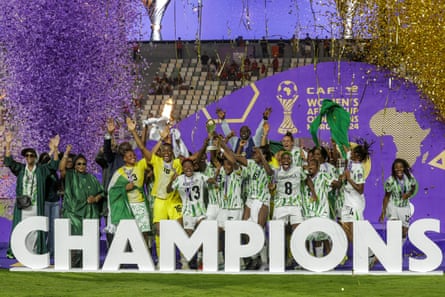
The competition’s most successful competitors, Nigeria, achieved “Mission X” and won their 10th Wafcon title in 2025, and it is difficult to look past them this time. They have retained the core of that squad, captained by Rasheedat Ajibade, but will be without the defender Ashleigh Plumptre because of a foot injury. The striker Asisat Oshoala and the goalkeeper Chiamaka Nnadozie headline their squad.
Morocco have been the runners-up in the past two editions and will be looking to go one better, especially as this could be the last in their trio of home tournaments. The 2028 Wafcon is set to be held elsewhere.
Other strong candidates are the 2022 champions, South Africa, who have an experienced squad, and Zambia, who were bronze medallists in 2022 and quarter-finalists in 2025.
after newsletter promotion
Who are the biggest stars?
Malawi will make their first Wafcon appearance, with many eyes on sisters Tabitha and Temwa Chawinga. Tabitha, who will captain the side, plays at European powerhouse OL Lyonnes, while Temwa is at Kansas City Current, where she has been voted the NWSL’s MVP for two successive seasons. She was also the highest-ranked African player on the Guardian’s 100 best female footballers in the world last year in sixth place.
Local fans will get behind the Morocco captain, Ghizlane Chebbak, who has won the Golden Boot at the past two Wafcons, scoring eight times across those tournaments. At 35 years old, this may be her last major tournament and she will not want to move on without a trophy.
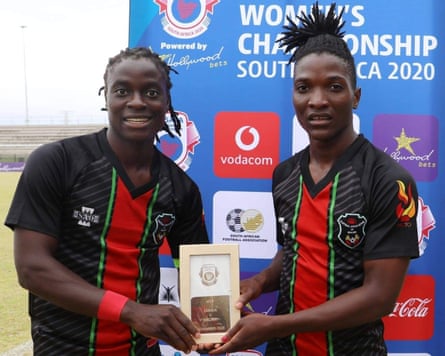
Zambia’s NWSL heavyweights Barbra Banda and Racheal Kundananji scored three goals each at the last tournament but could not take the team past the quarter-finals. Given their reputations the pair will be hoping to ensure Zambia can continue to enhance their reputation as serious continental challengers.
Ghana were the most improved side last year, when they lost to Morocco on penalties in the semi-final. Their forward Princess Marfo, who recently signed for PSV Eindhoven, and Evelyn Badu, fresh off a hat-trick for Montreal Roses, are two to keep an eye on.
What’s at stake?
In short: money and major tournament qualification. Prize money at the last Wafcon increased by 45% in total, with each team earning at least $125,000 (£94,000) and the winners, Nigeria, pocketing $1m. This time there is something else at stake too: the four semi-finalists will qualify for the 2027 World Cup in Brazil, while the four losing quarter-finalists will play off to decide which two teams advance to the inter-confederation deciders.