.png)
 1 month ago
68
1 month ago
68
On the ground floor of the Spanish football federation’s headquarters in Las Rozas are two classrooms covered with photos of everyone who has played for la selección. More than 800 men are there, frames spilling into the corridor, but the coach who leads them to the World Cup is not. Luis de la Fuente’s international playing career took him only as far as the under-21s so his picture is missing, which is a pity – “I used to have hair like this,” he claims, hands recreating flowing locks – but he knows this place well. This is where he taught; it is also, he says, where he learned, his pupils not alone in going on to big things.
The 2024 European Championship-winning coach settles into a sofa in a small room on the floor above. His squad named, these are the final days before flying to Chattanooga. Days of excitement and to “judge the load” as players clock in: 20 on the first day, Pedro Porro the next and Yéremy Pino the day after, then Mikel Merino and finally those who played in the Champions League final. Days to take it all in – “I’m so happy to be going to a World Cup” – and to take pride too.
From Spain it was not only Fabián Ruiz, David Raya and Martín Zubimendi who were in Budapest but also the managers: Luis Enrique, De la Fuente’s predecessor, and Mikel Arteta. Three days earlier, Iñigo Pérez led Rayo Vallecano into the Conference League final. The week before, Unai Emery lifted the Europa League. Pep Guardiola bade farewell as perhaps the most influential coach the Premier League has had. And Xabi Alonso has been appointed at Chelsea, Andoni Iraola at Liverpool. And that, De la Fuente insists, “isn’t chance”.
“This is a process that goes back a long time; at last it seems people are starting to appreciate it,” he says. “That appreciation should have happened ages ago. With trophies, it becomes more visible but the development, the way it is structured and conducted, the work done by coaching schools at regional and national federations, was always an example to everyone.”
He has seen it, a legacy left and taken, some satisfaction deeper than success. Not all of them came through here, but there is something about Spain’s football culture that shaped them, an ideal the national team coach embraces. And Iraola and Alonso did start here among these photos; so too Lionel Scaloni, the coach of this summer’s defending champions, Argentina, and many more. De la Fuente was among their teachers, coach of coaches, the experience shaping him as well; something in being a teacher, a guide, that was reflected in his role with Spain’s under-19s and under-21s and carries on now.
De la Fuente spent three years at the front of the room from 2017, some familiar faces looking back at him: more familiar than he was then. While coaching Spain’s junior teams, he taught two subjects on the federation’s Uefa pro licence coaching course: the evolution of football and team building. In the front row sitting by Montse Tomé, assistant coach when Spain’s women won the 2023 World Cup, was Scaloni. In the back row, Joan Capdevila, the class joker.
“It was just like school: the kids at the front and the kids that sit at the back,” De la Fuente says. He could hardly forget Capdevila, “so funny, always ready with a line”, and he certainly hasn’t forgotten Scaloni. He hasn’t forgotten any of them, eyes lighting up every time another name is thrown in, and it’s some list. “Laura del Río at the front with Leo and Montse … Xavi Hernández, Raúl, Victor Valdés, Albert Riera, Xabi. Xabi’s brother, Mikel. Alessio Lisci. Mauro Silva. Walter Pandiani. Javier Saviola. Pablo Amo, later my assistant. Andoni, Gica Craioveanu, Manuel Pablo …
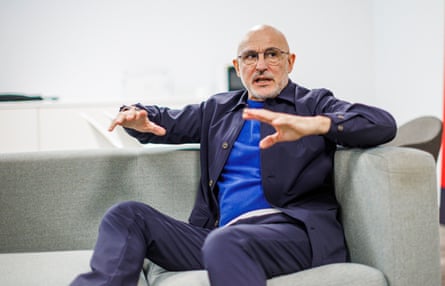
“It would be easy to now say Scaloni stood out but it is true that there were some who had something a bit different. That restlessness, how they would challenge you: ‘I don’t see it.’ Scaloni debated everything, argued. We’re similar too, a parallel in our paths. He starts at the under-20s, then made his way into the senior squad and won it all. He had to, we both did: it was win, win, win, win, because if we hadn’t … And what he had to take on with Argentina, woah, it’s a lot. I identify with Leo because of those experiences, how he sees life and handles these situations, people: normal, serene, no desire to blow things out of proportion.”
Within six years teacher and pupil would be European and South American champions respectively. Those successes should have brought a class reunion at the Finalissima in Qatar in March but war forced postponement. Alternatives were sought, but no agreement reached. “Two don’t play if one doesn’t want to; we were mad keen to play,” De la Fuente says. “It was a pity. I don’t think politics will be a problem this summer: football is something that can bring people together of all creeds, ideologies, races and religions. And it would be nice to see Leo at the World Cup and give him a hug.”
The holders against the favourites, and it all started here. “Who would have thought it?” De la Fuente continues. His first big senior job was this, past 60, having worked in Spain’s youth structure for a decade. Scaloni, 40 when thrust into the seniors, hadn’t worked at a club. “Life provides these moments. And nothing was given to us for free. It’s all through work, work and more work …”
Without his pupils, De la Fuente believes he might not have been here. “They gave me a different view, a vitality. For me, it is a constant apprenticeship. Teaching always attracted me, I had done courses in Bilbao and Sevilla, was at the federation. I love to talk football, and if you’re given the opportunity to talk football with Xabi, Xavi, Raúl, Scaloni … I liked to interact because I learned loads. It was an exchange of information, 30 of us in the room. That feedback, the demands they made of you as teacher, meant you got to class nervous and left better for it. It’s not just football, it’s life: you’re learning all the time. I learned to simplify, be more practical.
“In the end, sporting success is fleeting. But I remember my teachers … So when I had the chance to work at the RFEF [federation], I thought: it’s my job to shape people.”
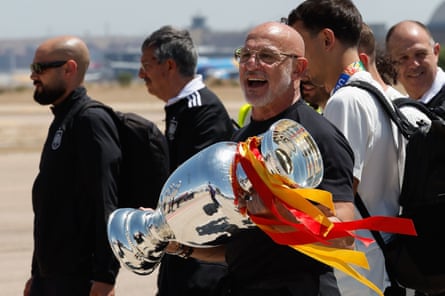
De la Fuente pauses, signals his glasses on the table in front of him. “Could you pass my glasses please? … thank you,” he says. “Players think: ‘The manager says please, thank you.’ It’s about educating, values, principles. Not anything goes, for goodness sake. I had a connection with a lot of our players going back a long time, before the senior side: Álvaro [Morata], Dani [Carvajal], Unai Simón, Fabian, Rodrigo, [Marc] Cucurella, Mikel Merino, [Mikel] Oyarzabal … In that sense, I am more than a coach.
“In a group there can be no selfishness; that human relationship is what gives you strength. We always referred to the team as a ‘family’ and then you find that players are doing it. We never told them to, it just happens. The closest similarity I see to the [Spain] team that went to 2010 and won the World Cup, which is the challenge we have in front of us, is in that togetherness. I spoke to Vicente del Bosque [the coach then] and he tells me things that I think: that’s us now.”
Rarely can that pastoral role have been more significant than with Lamine Yamal, called to la selección at 16, a schoolboy finishing exams while representing his country. Called to stardom too, arriving at the World Cup as perhaps the best player in the world at 18, with all the pressure that brings. All the more so given he has not played since April because of a torn hamstring; he admitted he had “prayed” it wasn’t serious, “scared” he might miss out.
“He’s getting better fast, hitting all the targets earlier,” De la Fuente says. “I think he’ll be able to play the first game, but that doesn’t mean [he will]. We’ll evaluate if he has to play a little bit, not play, wait for the second game.” As for the other part of it, he nods at Javier López Vallejo, la selección’s psychologist, sitting to his left. “This gentleman is so important,” he says.
So too the group around him, and that starts, De la Fuente says, with respect. “You want people who don’t allow ego, fights. If there’s a choice between a good player who’s a good person and one who’s a bad person, I have no doubt. The youngest ‘drink’ from the veterans’ experience, the veterans from the vitality of youth. The veterans have responsibility for the behaviour: ‘That’s not how we do things.’ If there’s trust, you can say that; if not, the response would be: ‘Who are you to tell me that?’
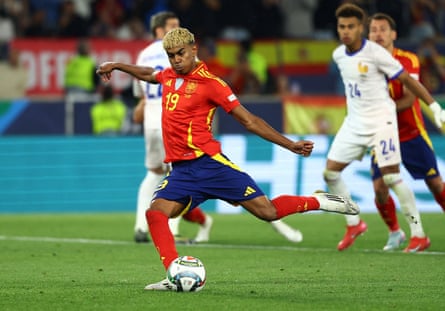
“Lamine was born for this. He has a daring character. Maybe that [pressure] would have overwhelmed you or me. But these guys are special. How many times have we asked of a player: ‘How good was that guy, what happened to him? Why didn’t he make it?’ Because you have to be good at football and a thousand things more. Lamine was 16 [at the Euros], 18 now, he puts up with a brutal media pressure and makes very few errors. One minute, one mistake, and the focus is on that; that’s not fair. There are hours, days, with physios, nutritionists, psychologists, coaches … it’s the work, the values.
“Footballers are people of high ability, so intelligent. They are geniuses and then there are those that are touched by God’s wand and there are very few of those. Lamine, Messi … ”
Touched by God’s wand or, in Lamine’s case, baptised by him, a baby photo famously appearing in which he is bathed by Messi. De la Fuente smiles. “Maybe Messi has picked up lots of babies,” he says. “Maybe it’s chance. But for those of us who have faith, who believe in something beyond, ‘chance’ is God’s pseudonym when he doesn’t want to sign his name. In life I think, everything happens for a reason.”
Is Lamine Yamal Messi’s successor? “Messi: those are big words. Messi has been, is, and will always be … he is football.”
The best player he has seen? “I always liked Johan Cruyff. And to be on a pitch with [Diego] Maradona was like: ‘What is this?’ Madness. And those were different times. People can’t imagine what it was like: it was absolutely savage, players were hunted down. But I recognise that Messi, like Cristiano [Ronaldo], is … unbelievable. I’m not saying it’s easier now but it’s changed: pitches are different, habits, equipment. Cruyff today would still be Cruyff, still spectacular. Could we play now? Yeah. Could these guys play then? No. We would run up and down hills, an hour up and an hour down.”
De la Fuente laughs. Talk about the evolution of football. “On Fridays, we would eat beans or a T-bone. After the session, the whole [Athletic Bilbao] team would be at the bar by Lezama: beer, wine, tortilla, peppers, the works. Have a siesta and play the next day. There is a lot of ‘literature’ now and, forgive me, maybe this isn’t very popular because I’m not at all literary, but I’m a coach with quite a classic concept of football. Yet everything evolves and you do too. I didn’t always have the tools to put my ideas into practice. With experience, I have. I see more clearly now. You are always learning, always: if you don’t see it like that, you’re making a mistake.”