.png)
 1 month ago
32
1 month ago
32
Nick Triggle and Philippa RoxbyBBC News

 Getty
Getty
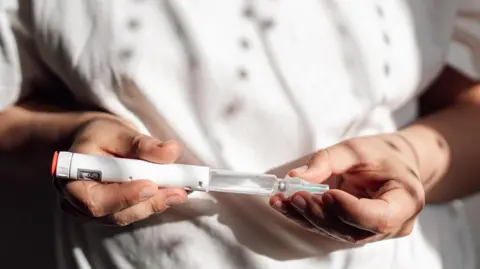
There are thought to be about 1.6 million people on weight-loss drugs in the UK.
Some people are able to get the injections through the NHS but most buy them privately. The most popular jabs are called Mounjaro and Wegovy.
The jabs are highly effective, but experts say users should be aware of the risk of weight gain once they stop taking the drugs.
How do Wegovy and Mounjaro work?
There are many drugs on the market for weight loss, which can be in the form of an injectable pen or a capsule.
Weight loss injections which can be prescribed by the NHS are:
- semaglutide, marketed under the brand name Wegovy
- tirzepatide, sold as Mounjaro
- liraglutide, sold as Saxenda
They are given as weekly injections via pre-filled pens that can be self-administered into the upper arm, thigh or stomach.
The drugs work as an appetite suppressant by mimicking a hormone called GLP-1 which makes people feel fuller. Mounjaro also affects metabolism and helps regulate energy balance.
Patients generally start on a low level dose which is gradually increased until they reach a maintenance dose.
They are always prescribed alongside healthier eating and exercise programmes.
How much weight do people lose and what happens when they stop?
 Getty Images
People typically start to lose weight within a few weeks.
Mounjaro's 20% weight reduction, after 72 weeks of treatment, exceeded the 14% for Wegovy.
The trial - funded by Mounjaro manufacturer Eli Lilly - involved 750 obese people, with an average weight of 113kg (nearly 18 stone).
The NHS has been urged to provide regular check-ups, support and advice to help prevent this.
It recommends the jabs for people who are overweight with obesity-related health risks, not people who just want to get a bit thinner.
Doctors should also prescribe lifestyle changes that include eating healthily and getting enough exercise to help people keep the weight off.
Who can get weight-loss drugs on the NHS?
Wegovy is currently available on the NHS in England, Wales and Scotland.
To qualify, adults must be obese (with a BMI of at least 35) and have at least one pre-existing weight-related health condition such as high blood pressure.
People with cardiovascular disease who are classed as overweight, but not quite obese, can also be given the drug.
Patients should follow a diet and physical activity programme, and the drug should be only prescribed for a maximum of two years.
 Reuters
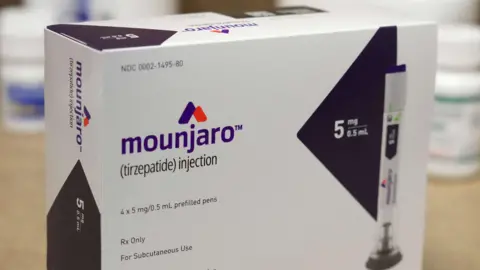
Mounjaro has been available from specialist NHS weight-loss clinics in England and Wales since March 2025.
- a BMI of 40 or over (or 37.5 if from a minority ethnic background)
- and four out of five of these conditions: type 2 diabetes, high blood pressure, heart and vascular disease, high cholesterol and obstructive sleep apnoea
Patients who are prescribed Mounjaro will also get regular check-ups, exercise support and advice on healthy eating.
It is thought around 3.4 million people could eventually qualify for Mounjaro.
What do Wegovy and Mounjaro cost to buy privately?
Wegovy and Mounjaro can both be bought privately, in supermarkets, chemists and high-street clinics. Estimates suggest nine in 10 pay for the drugs privately.
Pens typically cost between £100 and £300, depending on the dose.
The drugs should not be bought from unregulated sources.
The BMI of patients who have completed online questionnaires or sent photos must also be verified.
What are the side-effects of weight-loss injections?
The most common side-effects are feeling sick, vomiting, bloating, constipation and diarrhoea. Some people report hair loss.
For many, the side-effects are manageable and tend to go away in time; others say they stopped taking the drugs because of them.
Experts warn the complications can be worse if the drugs are abused, for example, taken as a quick fix to lose a few pounds.
In rare cases, serious side-effects can include gallbladder and kidney problems and depression.
 Getty Images
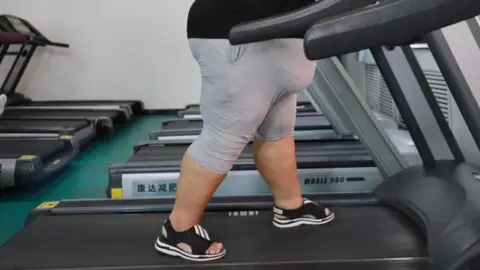
Obesity specialists say the drugs should be used alongside a programme of exercise and health eating
What are the warnings about pregnancy?
The UK's medicines regulator, the MHRA, has warned women that the lack of information about how the drugs could affect unborn children means they must not be taken:
- during pregnancy
- while trying to get pregnant
- during breastfeeding
The MHRA recommends that women taking the jabs consider using additional or alternative contraception.
What is obesity and what is a healthy BMI?
The term obese describes a person with excess body fat.
In the UK it's estimated that around one in every four adults is obese.
The standard way of categorising people's weight is by calculating their body mass index, or BMI.
For most adults, if your BMI is:
- below 18.5 – you're in the underweight range
- 18.5 to 24.9 – you're in the healthy weight range
- 25 to 29.9 – you're in the overweight range
- 30 to 39.9 – you're in the obese range
- 40 or above – you're in the severely obese range
- 23 to 27.4 – overweight
- 27.5 or above – obese
BMI has some limitations because it measures weight, not fat. Someone who is very muscular can also have a high BMI.
But for most people, it is a useful indication of whether they are a healthy weight.