.png)
 1 month ago
122
1 month ago
122
Well, that’s that then. Put out more flags. Mount the iconic Jedi‑style woollen cardigan in the club museum. He really does seem to be done this time.
In the absence of formal denials, it now seems highly likely the scheduled final year of Pep Guardiola’s Manchester City contract will be spent trawling the high-concept food ateliers of the Iberian peninsula, debating spatial architecture with a Slovenian Cluedo grandmaster over hummingbird martinis, and generally recharging after a decade of unceasing devotion to victory.
Probably, anyway. Barring some last ditch talks with – and this is significant – the vice-president of the United Arab Emirates, the dominant era of the 21st-century Premier League is now over. They’re selling Pep wigs in Woolworths, and it is time both to pay tribute and also, here at least, to talk about the oddly overlooked shadow story to that era.
The cultural impact of Guardiola‑ism has been discussed in gushing tones over the past two days. But this is also football, a place where everything, no matter how lovely, must also be tainted, where every butterfly is broken on a wheel. And Guardiola’s impact is also wrapped up in the other part of this story, the dark heart of his sport.
Not that you’d know it by the noise, which has been devotional, fawning and piously one-note. On Sky Sports, Micah Richards, also a club employee, discussed Pep’s departure in the awed, tearful tones of a man being forced to confront the death of his beloved pet rabbit. One BBC production labelled it “a seismic event in world football”. A seismic what now? A what kind of event?
Mainly the eulogies have reflected Guardiola’s outsized sporting status as the brain, heart and Stalinist-scale face of the entire City project. Rightly so in terms of medals and content. Guardiola has overseen the winning of 17 major trophies, or 55% of all City’s major trophies ever. His teams have been relentlessly beautiful, from the brittle, fearlessly transitional early years, through the hyper‑engineered machine of peak possession-ball, to the more adaptive late period, the Midnight Cowboy odd-couple relationship with a thrillingly efficient Nordic centre-forward.
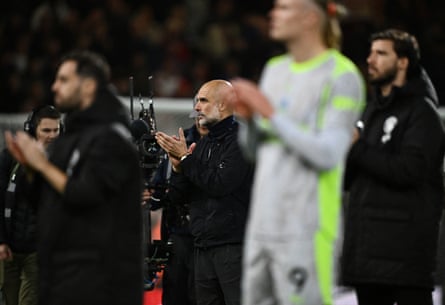
This isn’t surprising. Not only is Guardiola a managerial genius, there is an alluring, paradoxical purity to his methods. Critics may portray him as a kept man, a princeling of privilege, cosseted by bottomless funds and genius‑level talent; not just a fraud, but a bald fraud, the worst kind of fraud there is. But City haven’t just bolted on a team of proven victory‑psychopaths. This has been a rare feat of chemistry and abstract planning, a lesson in elite modern coaching, in how to build a team in the clouds.
Some favourite Pep-at-City moments: sticking with his methods through the early cultural outrage, the John Stones-has-bigger-balls-than-anyone-in-this-room era of defiance. Winning a league with Ilkay Gündogan as top scorer. Finessing and regearing young players, most recently Nico O’Reilly, a genuine gift to the English game. And, above all, his deeply seductive obsession, the feeling that Guardiola is always doing this, even when you can’t see him, the bandy-legged puritan alone in his glass penthouse, still whirling his arms like an insurgent warlord semaphoring attack formations to his helicopter gunships.
“Never relax” is one of Guardiola’s managerial mottos, which has always seemed unnecessary advice, from the time at Bayern Munich when he became so contorted with horror and elation during a game against Porto that he split his trousers, offering to the world an unusually intimate glimpse of his passion, desire and navy blue underpants; to the gripping recent press conferences where the intensity of Guardiola’s engagement can seem more unnerving than the standard industry distance, as though Emperor Palpatine has suddenly started telling jokes and asking after your family.
It has been fun, thrilling and aesthetically lovely. But all of this has a function, too. It exists by design, a gloss on the real point of the whole thing. The cultural influence stuff may have been overplayed in the past few days, as though Guardiola has been out there touring the country ripping out rusted 11-a-side goals with his own hands. But the hard cultural element to Guardiola’s legacy is just as real. And this has involved the normalising of other things.
Most obviously, the fact we can simply live with charges of financial cheating on a profound scale, even if they remain simply charges, flatly denied by City. And second that this is all owned and administered by a government, that Guardiola is acting as a puppet for a repressive nation state just by doing his job. Like it or not, the sporting glory has been played out as a giant advert board for his soft-power paylords, accompanied, below the fizz and the cheers, by politics, power grab and the clank of the scythe.
The most obvious point is the allegation of cheating. And yes, by now this is all a little lost in the fog. But to be clear, every one of Guardiola’s trophies has been won in the era of charges, around 40 of which relate directly to his decade. This matters in a sport where expenditure is rigidly correlated with success. It matters, too, because whatever you think of the rules, most other teams were sticking to them, and because since the end of his first season City have had the most valuable squad in the league according to Transfermarkt, and because four of those league titles were won by narrow points differentials.
It is worth going through this. In Guardiola’s first season City spent £135m on Stones, Gabriel Jesus, Leroy Sané and Gündogan, serious title-winning players. They are also accused of not submitting properly detailed accounts that year. In his second season City spent more than £180m and won the league by 19 points. Again, they are accused of not submitting properly detailed accounts.
In Guardiola’s third season City spent £146m, bought Riyad Mahrez and won the league by one point. They are also accused of not complying with the league’s profitability and sustainability rules. In 2022 they won the league by one point and then bought Erling Haaland and Julián Alvarez, and are accused of not cooperating with the league’s investigation. Again, City deny all of this. But even if you think the rules are unfairly restrictive of billionaire freedoms, this is entirely material to the story being told of transformation and constant success.
We know these margins make a difference because City themselves lost a Champions League final to Chelsea, who have since been charged with breaking financial rules at the time. The game’s subplot related to tactical overthinking, the erasure of the defensive midfield role, is also muddied by financial chicanery. In a sport where all stories are outcome-based, the whole thing falls apart.
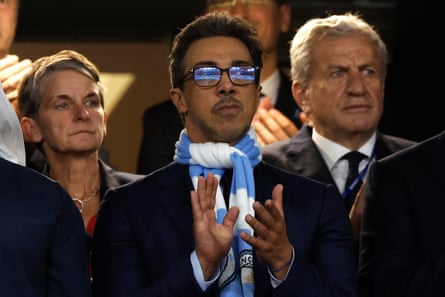
The charges may well be waved aside, leaving only righteous glory. But we still have the very real point that this is all being done in the service of a nation state. For some reason a country owns an English football club. And the UAE is not a neutral entity. Its presence in sport is a propaganda project, a way of making you think about football rather than dwelling on, for example, the very recent accusation by 65 Yemeni human-rights organisations of the UAE’s complicity in killings, detention and torture. This is what states do. The UK and Nato are constantly engaged in theatres of suffering around the world. But we’re talking about the owner of a football club here, about Guardiola’s employers, a regime that is openly manipulating the cultural attachment of football fans.
These factors do not discredit Pep’s legacy. They are his legacy. They tell us about football and the world, about the overclass and the power of spectacle. But this also doesn’t have to happen. Or if it does, it doesn’t need to be left unremarked, as though it isn’t material to the noise and colour. It affects its host body, too. It robs it of something. There is a basic coldness to City’s success. From the moment Abu Dhabi took over it was inevitable the club would win the Champions League, just as we already knew Guardiola was the greatest coach in the world, that hiring his precooked brains trust would guarantee success. This is a straight line equation: money plus talent equals victory. What does it really tell us, if anything, about sport, talent, opportunity, Manchester?
Guardiola’s brilliance has been vital in giving the project heat and life. But it also diminishes him, requiring him to express not just sporting greatness but the emptiness of billionaire culture, a place of managed greatness, elite‑grade product. Paradoxically, the charges have at least leant City’s project a note of defiance, a chance for a club owned by a sovereign wealth fund to present itself as an underdog kicking against the old powers, raising its fist to the cartel, while also getting to be the richest and most powerful player in the field.
All that really seems certain is that City will be back. This is not the end. The end cannot exist for clubs with these resources, right down to the generalised shrug at the slightly Moyesian succession plan. Enzo Maresca is sharp, talented and fully Pep-pilled. Intense, bald, bearded systems-man shall beget intense, bald, bearded systems-man. It may all work out pretty well. Either way, for all the talk of legacy and departing genius, the project will go on.