.png)
 1 month ago
63
1 month ago
63
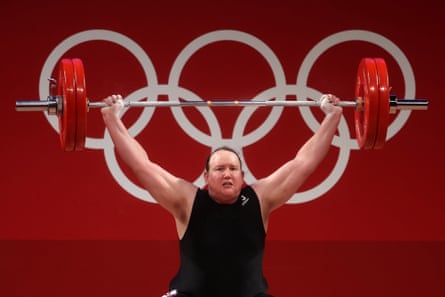
By any measure, it amounts to one of the most astonishing U-turns from a governing body in modern times. Four and a half years ago, the International Olympic Committee was lauding the appearance of the first transgender weightlifter, Laurel Hubbard, at an Olympics, and issuing a framework to sports saying that transgender women “should not be deemed to have an unfair or disproportionate competitive advantage” over biological women.
Now it has not only ripped up every last morsel of that guidance but also performed a spectacular 180-degree turn.
Over 10 tightly worded pages, the IOC now states that the female category must be protected for fairness and safety reasons, and makes it clear that SRY screening – a sex test using saliva or a cheek-swab – will be used to determine biological sex.
It is a monumental shift that means transgender women and athletes with differences in sex development (DSD), who were reported as female at birth but have internal testes and have undergone male puberty, are now banned from the female category at all future Olympics.
It has caused anger among some groups, joy among others. But what is behind such a handbrake turn, which will be heard all the way from the IOC’s home in Lausanne to Los Angeles? And why did it happen?
In conversations with multiple sources in IOC and sporting circles, the same names come up: Kirsty Coventry, Imane Khelif and even Donald Trump. But, perhaps surprisingly, there is also broad agreement that the IOC was pushing at an open door – in private, most sports had been urging it to introduce such a policy for some time.
Was there one moment where the mood began to shift? For most sources it came amid the furore surrounding the Olympic women’s boxing tournament in Paris, and the questions over whether Khelif had a DSD, and thus an unfair advantage.
It should be stressed that many in the IOC had huge sympathy for the Algerian gold medallist who was raised as a girl. However, by late 2024, when the Guardian asked its executive director, Christophe Dubi, about the issues arising from the women’s boxing tournament, he admitted the situation “would be addressed”.
A second significant factor was the election of Kirsty Coventry as IOC president last March. During her campaign, she – along with her rival Sebastian Coe – made it clear that she would protect the female category. And having got into office she wasted little time in setting up a working group to examine the issue.
“This is something that I promised to do,” Coventry told the Guardian on Wednesday. “I wanted to make sure that I’m fulfilling what I’m telling people and that I’m not just a mouthpiece.”
Notably, one thing stood out most of all in an IOC survey of 1,100 athletes, many of them female Olympians or former Olympians: the majority of the women were in favour of change.
As Dr Jane Thornton, the IOC’s director of health, medicine and science, noted on Wednesday: “There was a strong consensus that fairness and safety in the female category requires clear, science-based eligibility rules, and that protecting the category was a common priority.”
Then there was the science. It is hardly news that males are stronger, faster and have better endurance than females. As the IOC policy document makes clear, that advantage is 10-12% in most running and swimming events, and greater than 100% in events that involve explosive power, including collision, lifting and punching sports.
The big difference in recent years is there have been more studies that show that when even men reduce their testosterone levels, that male advantage is largely still retained. In the others, transgender women and DSD athletes retain an advantage over natal women even after hormone treatment, because they have undergone male puberty.
That, the IOC decided, meant that they needed to be banned in order to ensure fairness and safety in the female category.
As the IOC puts it in its new document: “In light of the scientific consensus that males have a performance advantage in all sports and events that rely on strength, power and/or endurance irrespective of subsequent testosterone suppression or gender-affirming hormone treatment, the Olympic Movement has a compelling interest in having a sex-based female category, because this is necessary to ensure fairness, safety and integrity in elite competition.”
The vibes have also changed within sport. A few years ago, many sports felt there must be a way to balance fairness and safety for women while also being inclusive towards transgender and DSD athletes. The science has shown otherwise – and led to sports such as athletics, swimming and boxing introducing policies to protect the female category.
And what of Trump? Well, there is an agreement that his signing of an executive order banning transgender athletes has concentrated some minds in the IOC in the run-up to the LA Games in 2028. However, as Coventry pointed out on Wednesday: “This was a priority for me way before President Trump came into his second term.”
This issue isn’t entirely settled, despite the IOC decision. For a start, it applies only to elite sport. And there could still be battles ahead at the court of arbitration for sport if transgender or DSD athletes decide to challenge it.
However, whichever side of this issue you fall on, one thing is clear: a seismic shift has taken place.