.png)
 1 month ago
71
1 month ago
71
3 hours ago
Laura Bicker,China correspondentand Osmond Chia,Business reporter

 Bloomberg via Getty Images
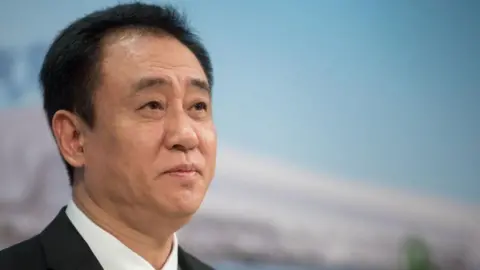
Hui Ka Yan, the founder of China's Evergrande Group
Hui Ka Yan, the founder of embattled Chinese property developer Evergrande, has pleaded guilty to a number of charges including embezzlement of assets and corporate bribery, according to a statement issued by the court.
Hui expressed remorse during the public hearing on 13 and 14 April, in the city of Shenzhen, according to Chinese state media.
The court said it will announce its verdict on the case at a later date.
Evergrande was once China's biggest real estate firm, with a stock market valuation of more than $50bn (£37bn), but collapsed into a debt-driven crisis in 2021 that has unravelled its business.
The court heard that the company had taken millions of dollars in pre-sale funding from potential house buyers that were not used for construction. Instead the funds were diverted to new projects which resulted in hundreds of unfinished properties across China.
Hui, also known as Xu Jiayin, rose from humble beginnings in rural China, where he was raised by his grandmother before venturing into property development and setting up Evergrande in 1996.
Evergrande became known as the world's most indebted property developer after much of its empire was built on $300bn of borrowed money.
But its business was dealt a blow when Beijing introduced new rules in 2020 to control property debt in the country, leading Evergrande to sell its properties at big discounts to ensure that money was coming in.
Hui was once Asia's richest person with a fortune estimated at $42.5bn in 2017, according to a list of the continent's wealthiest people compiled by Forbes.
His company grew rapidly, lifted by an economic boom in China that was driven by heavy borrowing.
The business empire expanded beyond property and into making electric cars and food and drinks. The firm also bought a majority stake in Guangzhou FC, which became China's top football team.
Evergrande's stock market valuation shrank by 99% before its shares were taken off the Hong Kong exchange in August 2025 after more than a decade and a half of trading.