.png)
 1 month ago
53
1 month ago
53
Fifa’s justification for its proposed plans to sell stakes in the World Cup to private investors is about giving the 211 member associations more money to develop football. It’s safe to say that in the past, funds have done more developing in some places than in others, with millions either going missing or not being used for their original purpose and Fifa too often shutting the stable door after the horse, laden with cash, has ambled out.
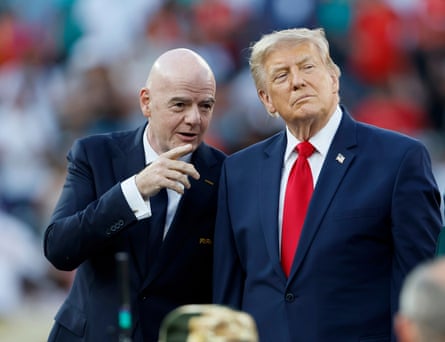
The reaction has been swift. Uefa has declared its outrage, Concacaf – the North, Central American and Caribbean governing body – has gone for concern and the Asian Football Confederation (AFC) is disappointed at the lack of consultation. From the Confederation of African Football (Caf), there is, as yet, no word. Asia and Africa have over the years provided Gianni Infantino with steadfast support. There were murmurs over the Fifa president’s close relationship with Donald Trump during the World Cup, especially during the Folarin Balogun affair, but extra cash may help prevent anything louder coming out of Kuala Lumpur or Cairo.
The sums on offer are significant – with promises of “over $10bn” (£7.5bn) being redistributed – and could do significant good, especially in countries that lack the infrastructure and facilities the big powers have. In the past, however, there has often been too little oversight too late when checking if the money that flows down from Switzerland actually trickles into all the necessary places around the world. This may not be surprising given that, according to reports, only about a fifth of federations actually return audited accounts detailing how the money is spent.
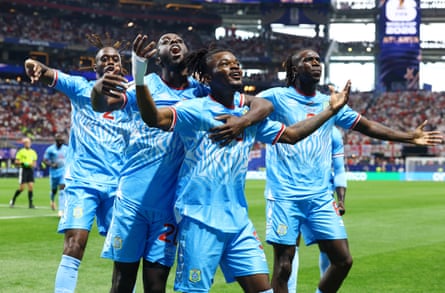
For example, between 2015 and 2025, the Nigerian Football Federation (NFF), is believed to have received more than $20m in development grants from Fifa and Caf. In 2024, the chairman of the Professional Footballers Association of Nigeria task force, Harrison Jalla, demanded that the NFF account for the money. “What happened to these funds from Fifa and Caf?” he asked. “All these funds disappeared into thin air and translated into huge debts.”
In October, it was announced that the Nigerian parliament was to launch an investigation into the federation’s activities. Behind the motion was the lawmaker Adedayo Adesola. “There has been a significant absence of visible improvement or grassroots growth in Nigerian football, despite these massive financial interventions,” he said. “There is a need to take decisive action to stop further misuse of public funds by the leadership of NFF.” Last week, the senate committee on sports criticised the federation for repeatedly failing to honour invitations to account for expenditure.
In March, Jean-Guy Blaise Mayolas, president of the Democratic Republic of the Congo’s football federation (Fecofoot) was convicted on charges of embezzling $1.3m of Fifa funds. It was claimed that Mayolas had misappropriated much of the money that was expected to be used to fund a training centre, women’s football and Covid relief. In 2019, Fifa banned the Caf executive committee member Musa Bility for a decade for “having misappropriated Fifa funds”.
In Asia, there have been plenty of issues too. In June, Fifa suspended Nepal’s FA due to third-party interference but football in the Himalayan nation had been in turmoil for years. It had funds cut off by Fifa in 2021 after financial irregularities were discovered. In 2014, the then FA president, Ganesh Thapa, was investigated by Nepal’s anti-corruption agency, the commission for investigation of abuse of authority, but this was put on hold the next year. In 2015, however, he was banned by Fifa for 10 years after it ruled he had “committed various acts of misconduct over several years”.
In neighbouring India in 2024, Nilanjan Bhattacharjee, the legal head of the All Indian Football Federation, accused the president, Kaylan Chaubey, of corruption and a lack of transparency in using federation funds, charges the latter strongly denied. The AFC asked Bhattacharjee, who was fired for his comments, to submit any evidence. He said he had done so, but so far, there has been no official response from the AFC or the football federation.
after newsletter promotion
In Bangladesh, more than $7m was allocated between 2016 and 2022 for football projects but only about $620,000 was reportedly used. In 2023, Fifa published a report detailing the financial irregularities it had found. Abu Nayeem Shobag, general secretary of the Bangladesh Football Federation, was banned from the sport.
Fifa said: “Specifically, it is alleged that Mr Shohag – whilst maintaining his position as General Secretary – participated in procurement and payment processes (within the BFF) which were supported with falsified quotations/documentation and subsequently paid for, or expected to be paid for, with FIFA Forward funds.” Shohag, who denied the accusations, appealed and took the case to the court of arbitration for sport but the original decision was upheld in 2024.
Whatever happens, more transparency on how such cash – which is, after all, generated by football – is used and more oversight can only be a positive. That’s because history shows that more money given to federations does not automatically equate to investment in football, regardless of what Fifa says.