.png)
 1 month ago
63
1 month ago
63
1. Matt shines as he paints town red
Hampshire and Essex, two teams hoping to draw a line under a lacklustre 2025, faced off at the Rose Bowl and tried to capitalise on the spring in the step that April always brings. It was to prove a sobering three days for the home side, who were dispatched by an innings and plenty. Another long season is now stretching out in front of them.
Their chief destroyer was Matt Critchley, the all-rounder surprisingly still the right side of 30. He arrived at the crease after his captain, Tom Westley, suffered a broken finger and made way for first injury replacement in Championship history – Noah Thain, future pub quizzers. Critchley cruised to 173, before Simon Harmer and Shane Snater’s fun was curtailed by the declaration coming with 500 in sight. Hampshire’s first innings started with seven wickets inside 26 overs and, following on, their second innings finished with seven in 22, five of which fell to Critchley’s leg-breaks. You can’t win matches like that.
A post-Ashes April is always a time to speculate on England call-ups. Critchley is seven years younger than Liam Dawson, who he comprehensively outplayed in this match, and the pair have very similar first-class records. He is a long way back just now, but is in the “we could do a lot worse” category.
2. Red-faced Leicestershire left cheesed off
Leicestershire returned to Division One after more than two decades away, with crisis club Sussex seemingly ideal opponents for a morale-boosting home win at Grace Road. That said, cricket seldom sticks to an easy narrative and experience won out.
Ian Holland, stepping into the unexpectedly vacant captain’s role after Peter Handscomb’s family commitments kept him in Australia for the season, followed suit with all his fellow captains (except Lancashire’s James Anderson) and decided to bowl. With Sussex batting all the way to his opposite number, Ollie Robinson, at 10, that looked a very ballsy call and, one down and 346 behind at the end of day one, so it proved.
Robinson is as wily an operator as you will find on the county circuit and it won’t just be Sussex fans wondering if leadership can strengthen the mental and fitness sides of his game, too often weak links at international level. He and his fellow seamer Henry Crocombe took five wickets each in the first innings, with Crocombe adding four more in the second dig for a fine personal match.
Leicestershire were more than 100 runs short in both innings – a reminder of the gap between the divisions – and face a daunting trip to the Oval next.
Henry Crocombe excelled for Sussex as Leicestershire were well beaten at Grace Road. Photograph: John Mallett/ProSports/Shutterstock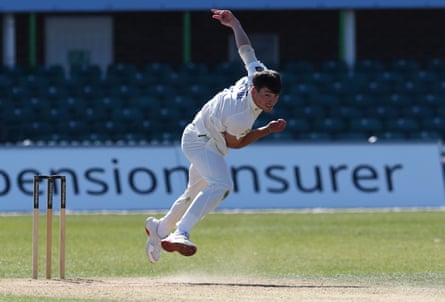
3. Overton’s declaration overkill
It’s a recurring gripe of this column that captains are too cautious in their declarations and too wary of defeat to seize the chance of victory. If there’s one county you would expect to take that criticism to heart, it’s Somerset, who have been runners-up in the Championship six times in this century alone. They welcomed Nottinghamshire to Taunton on the opening weekend.
As day four dawned, the home side were in total control against the reigning champions, leading by 223 runs with nine wickets in hand. Nottinghamshire were staring at a deflating start to their title defence and a significant points gap to a real rival before the Easter holiday was done.
The Somerset stand-in captain, Craig Overton, batted for another 34 overs to set a wholly unachievable 417 in 60 overs, inviting Haseeb Hameed to bat – which he and his teammates did. Of course, the pitch was benign. The Somerset centurions (Tom Abell, Tom Kohler-Cadmore and James Rew) could attest to that and, with his own 26 overs producing only one dismissal, Overton knew wringing wickets from the surface wasn’t easy.
Faint heart never won fair lady; Somerset drew a match they could have won.
4. Carlson falls short of checkmating Yorkshire
Not far north, at Sophia Gardens in Cardiff, Kiran Carlson had other ideas. Perhaps thinking that Glamorgan would be forced into home draws by the weather later in the season, he knew he had to take every opportunity to grab a win if his newly promoted side were to survive in the top flight.
Colin Ingram’s century, supported by some fine late middle-order batting, had been backed up by Mason Crane’s five-fer to yield a handy 76-run lead on first innings. Perhaps sensing blood given that his opposite number, Jonny Bairstow, was out injured, Carlson declared before lunch on day four, asking Yorkshire to make 295 from 68 overs. That’s more like it.
Adam Lyth, 11 years Carlson’s elder, might have given the cocky captain a look as he took guard in pursuit of such a gettable target and, at 125 for 1 with 170 to get in 33 overs, he might have ventured a word too. But the leg-spinner Crane, who must have been revelling in the belief his captain had shown in him, dismissed the experienced No 3 Sam Whiteman and then James Wharton, and soon the visitors were hanging on, seven down, at the close.
As any Australian will tell you, there is no such thing as a moral victory, but Glamorgan can take the positives out of this draw.
5. Du Plooy plundering runs again
It was a cold Good Friday that greeted the long-suffering faithful at Lord’s, back for another year of parlously financed Middlesex cricket. The landlords were building again, the Allen Stand being upgraded, leaving a gap where my preferred big screen once sat. I stopped counting how many times I looked for the score in that void at half a dozen.
However, one man was seeing exactly what he wanted to see, Leus du Plooy backing up last season’s valedictory 263 not out against Gloucestershire with 182 six months later, getting splendid support from a busy Joe Cracknell, their sixth-wicket stand of 181 establishing an ascendency that was never really challenged. Toby Roland-Jones picked up a fivefer and there were more encouraging signs from teenage pacer, Sebastian Morgan, with four second-innings wickets to secure an innings victory.
Before play, there was a poignant minute’s silence for the late Mick Hunt, the long-serving groundsman and “Mr Lord’s” for many of us who like to arrive early at HQ. His beloved turf looked beautiful after its winter relaying, but it was desperately slow and the fact that 16 of 29 dismissals were bowled or LBW tells you all you need to know about a slow, low deck on the square.
It’s almost as if the first week of April might be a bit early for The Summer Game.
6. Anderson thwarted by Sanderson
It would be unfair to condense four days of combat on first-class cricket’s vast canvas into a single Georges Seurat-esque point – and more unfair to blame one man for the result.
Lancashire’s Michael Jones dropped a straightforward catch at third slip offered by Northamptonshire’s No 11, Ben Sanderson. There were still four overs of long-shadowed struggle to go, but the Lancashire fans’ fatalism was in full bloom and Sir James’s men could not ride to the rescue.
It is fairer to praise the Northamptonshire tail, who took the first innings from 103 for 6 to 258 all out and the second from 50-6 to 213-9, George Bartlett’s 95 not out leading the hour-long 10th-wicket stand at the death. Runs after the fall of the sixth wicket are so critical in two-innings matches.
This article is from The 99.94 Cricket Blog