.png)
 1 month ago
73
1 month ago
73
It was another one of those games where Arsenal had found it necessary to rouse the troops beforehand. Mikel Arteta, in his occasional, unusual jokey mode, had urged Arsenal fans to bring “your lunch, bring your dinner” and make this 12.30 kick-off an occasion.
The players, meanwhile, had been training under the eye of a big screen broadcasting footage of Arsenal in happy, successful moments, presumably to encourage the creation of more. “Every game, we have to be there,” Arteta said. So were they?
The first half panned out much like many would have expected: a tight, intensely physical contest with Bournemouth exploiting weakness on the Arsenal right to take the lead and the home team responded with an equaliser from a set piece (a penalty, but one that came off the back of a corner routine).
Arsenal’s best player in that half was Viktor Gyökeres, whose offerings on the ball were limited, but whose determination and focus were unrelenting. In the moment of the penalty he took the ball from Kai Havertz – asserting his authority as centre-forward – and finished calmly. This steely approach is the kind that has underpinned many Arsenal victories this season. So far, so present.
Sadly for the prospects of Arsenal winning a first league title in 22 years, there are two halves to every match and the second was an eye-opener. The crowd was up for it, led by the drum ensemble in the Clock End, and the game restarted at a higher tempo. There was a sense that the final 45 minutes would be a contest between two teams trying to win. Not so.
A rare treble substitution nine minutes into the second half by Arteta, with Arsenal on the front foot, completely changed the game. It is hard to put a finger on quite why, it was simply one ineffective attacking trio replaced by another, but perhaps it was the time taken establishing new connections, players thinking they had a moment to assess the situation when they did not, that gave Bournemouth the chance to seize the momentum.
In the 65th minute, Gyökeres had the ball in the net for a second time, but it was ruled out for an easily avoidable offside. This was a brief interlude during increasing Bournemouth dominance, which was capped in the 74th minute by Alex Scott’s excellent goal, a cool finish to a slick carousel of passing across the edge of the Arsenal penalty area.
Six minutes later, Gyökeres had another good chance after Djordje Petrovic got a poor punch to a Max Dowman cross. With the space to take a touch, the Swede still screwed his shot wide of the post and had not appeared to have made a clean connection.
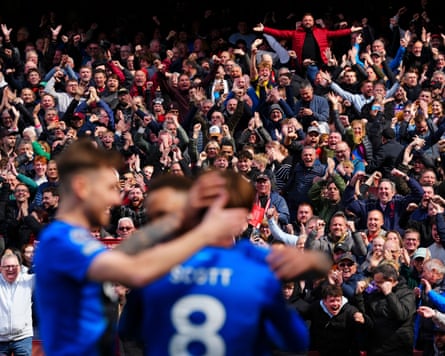
Gyökeres finished the game playing deeper than Gabriel as Arteta decided his centre-half would be the point of any attacking spear as his team sought an equaliser. This is an indictment, but less of one than the tempo at which those closing minutes were played: slow and ponderous. The instinct was to think Arsenal had been bound up by nerves, if it was not for the fact this was the pace at which they had played almost the entire match.
The pace had to be slow because Arsenal did not have the combinations to play more quickly. They were about winning yards, winning fouls and seeking to hurt Bournemouth from the resultant deliveries. Arsenal registered 1.44 expected goals from set plays, more than the 1.2 Bournemouth managed in total. The thing was that Bournemouth’s chances all came from open play. For Arsenal, open play opportunities added up to 0.19xG, the second-lowest total they have recorded at home since these things were first calculated.
So were Arsenal really there? They didn’t win, so in the strictest terms of Arteta’s definition, they were not. Alternatively, you could argue this was a Schrödinger’s Arsenal, a team that could be either dead or alive, depending on what was going on in the area at any given time. More disconcerting for those committed to north London for ever is the possibility that Arsenal were there at this match and just weren’t good enough to win against a side that have successfully regenerated after a summer of sales, with an enduring playing style that supersedes the importance of any individual contribution.
Arsenal remain nine points clear at the top of the league and in a season when any number of matches have been held up as turning points only to prove to not quite be so it would be hasty to call this defeat decisive. But tif Manchester City win all their games that nine-point gap will be eaten all up. Arsenal now not only have to deal with the pressure of being hunted down by serial winners – something all the pre-match noise suggested they are struggling with – but they will have to find a way to win games beyond grit, determination and deliveries from Declan Rice’s right boot.