.png)
 1 month ago
76
1 month ago
76
40 minutes ago
Pallab Ghosh,Science Correspondentand Alison Francis,Senior Science Journalist

 Reuters
Victor Glover and Christina Koch pictured after the crew's successful return to Earth
The four astronauts who flew in Nasa's Artemis II mission around the Moon have splashed down safely in the Pacific Ocean after a flawless return.
The crew are now safely aboard a waiting ship and recovering from a nine-day voyage that took them further from Earth than any humans in history.
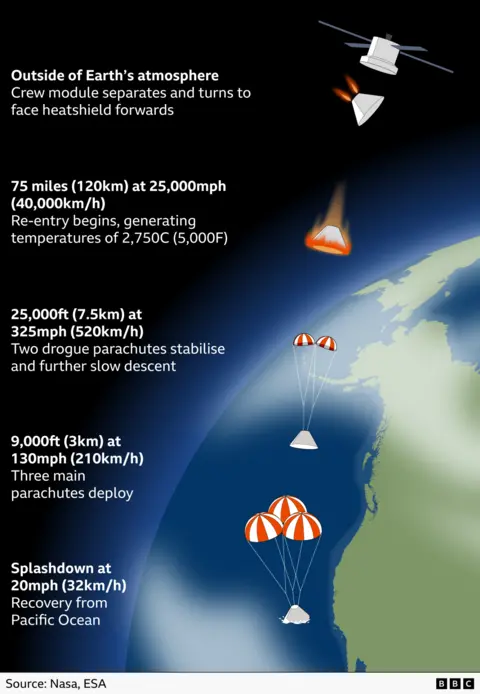
Their Orion spacecraft was travelling at more than 24,000mph (38,600km/h) when it hit the Earth's upper atmosphere and its heatshield was subjected to temperatures half as hot as found on the surface of the Sun.
Their safe return clears the way for the next stage of the Artemis programme, which aims to land humans on the lunar surface and eventually build a permanent base on the Moon.
The extreme heat meant the capsule, which the astronauts named Integrity, lost contact with mission control in Houston for six minutes during the descent.
There were cheers when Commander Reid Wiseman's voice was heard saying: "Houston, Integrity here. We hear you loud and clear."
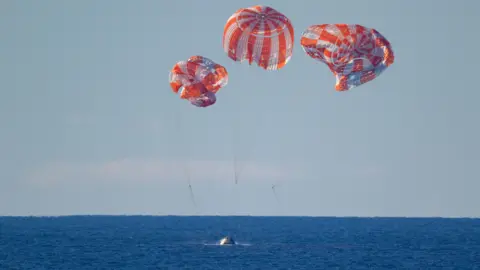
The mission's moment of maximum jeopardy had passed, and soon the spacecraft's red-and-white parachutes opened and sent the capsule sailing majestically through the sky.
"Good main chutes!" the Nasa commentary enthused repeatedly, until the capsule hit the ocean for a perfect splashdown.
"A perfect bull's eye splashdown for Integrity and its four astronauts," Nasa commentator Rob Navias said moments after the landing.
 Getty Images
The crew capsule, named Orion, splashed right on schedule in the Pacific Ocean, within a mile of its target
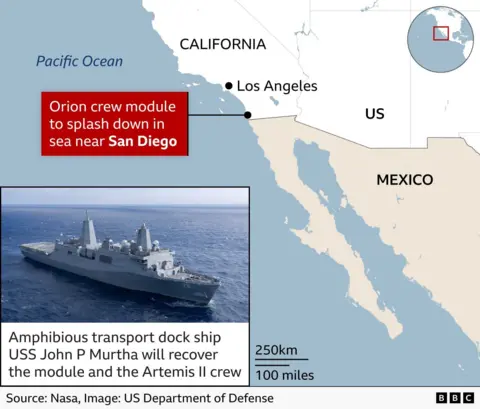
The astronauts - Wiseman, pilot Victor Glover, mission specialist Christina Koch and Canadian astronaut Jeremy Hansen - were carefully extracted from the capsule and taken by helicopter to the USS John P Murtha, where they will undergo medical evaluations.
Nasa said they would be flown to Houston to be reunited with their families on Saturday.
As they waited on the ship's deck they could be seen smiling and chatting while posing for photos.
President Donald Trump welcomed them home and said the entire trip had been "spectacular", repeating an invitation for them to visit the White House.
Nasa has not yet confirmed when they will make their first public appearance.
At a press conference, Flight Director Rick Henfling said there had been a lot of anxiety but also a lot of confidence while bringing the Orion crew home.
"We all breathed a sigh of relief once the (capsule's) side hatch opened up," he said.
"The flight crew is happy and healthy and ready to come home to Houston."
Lori Glaze, acting associate administrator at Nasa, was full of praise for the astronauts.
She said the four were all individually impressive, but that she was proud of their "teamwork" and "camaraderie".
"I think they really brought an amazing sense of what we were trying to achieve," she added.
"It was a mission for all of humanity."
 NASA
NASA
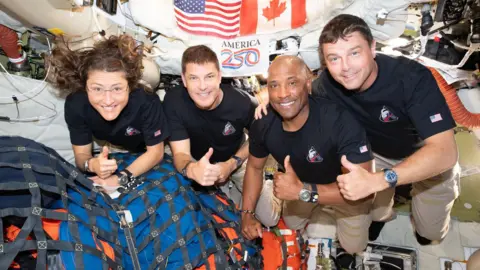
Thumbs up from the history-making crew: L-R Christina Koch, Jeremy Hansen, Victor Glover and Reid Wiseman
The Artemis II mission began its final descent at 19:33EDT (23:33GMT) when the European Space Agency-built service module - the cylinder of engines and solar panels that powered Orion throughout its lunar journey - detached.
Live pictures showed the capsule push gracefully away, homeward bound.
Next came the riskiest part, between re-entry into the Earth's atmosphere and splashdown.
The capsule's angle of approach had to be precise: too shallow and Orion might skip off the atmosphere like a stone off water; too steep and the heat would be damaging.
In the event, according to Nasa's TV coverage, the angle of attack was perfect and the capsule hit a narrow target of sky southeast of Hawaii as it headed for the Californian coast.
There had been concerns over the spacecraft's heatshield, which protects the capsule from the extreme heating as it slams into the thickest part of the atmosphere.
In the previous, uncrewed test flight of the Artemis system in 2022, the Orion capsule's shield suffered unexpected damage which raised questions about how hot the interior might get on a crewed mission, even though temperatures on Artemis I stayed within safe limits.
Engineers responded by changing the way the spacecraft re‑enters the atmosphere that simulations showed would reduce the thermal load on the shield. This mission was the first time that new return path has been tried in flight.
We'll have to wait for the full data to see how much the heating was reduced, but whatever the engineers decided clearly did its job of bringing the crew safely home.
Speaking at the press conference, Nasa associate administrator Anit Kshatriya contrasted the precision of that angle with the 250,000-mile journey to the Moon.
"The team hit it, that is not luck, it is 1,000 people doing their jobs," he said.
The Artemis programme aims to step up Moon exploration, land humans on the Moon for the first time since 1972, set up a permanent lunar base and aim for a crewed mission to Mars.
The next flight, Artemis III, has been redesigned under Nasa's new administrator Jared Isaacman to be an Earth-orbital mission to test rendezvous and docking with the SpaceX and Blue Origin lunar landers, and is pencilled in for mid-2027.
The first actual Moon landing - Artemis IV - is targeted for 2028, though there are doubts that target is achievable.
Today's homecoming does not put boots on the Moon. But it confirms the hardware works, the trajectory holds, and the people can take it.