.png)
 1 month ago
87
1 month ago
87
2 hours ago
Nadine Yousif,Senior Canada reporterand Sareen Habeshian

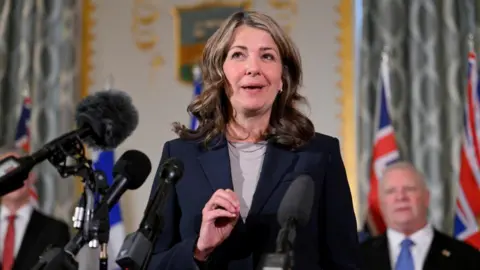 Reuters
Alberta separatists have publicly pressured Premier Danielle Smith to include a question on independence in an October referendum.
Alberta will hold a referendum on whether the province should remain in Canada or move ahead with a second binding vote on separation, marking the first significant test of the country's unity in decades.
Thursday's announcement by Premier Danielle Smith comes after a citizen-led petition calling for separation gathered more than 300,000 signatures early this year and a separate petition advocating for Alberta to stay gathered more than 400,000.
A restive independence movement has been growing in the oil-rich province, built on a long-held sense that Alberta is overlooked by decision-makers in Ottawa.
Still, opinion polls suggest that the majority of Albertans would vote against separating.
The provincial referendum has been scheduled for 19 October, the premier said.
Smith, in a televised address, said the question being put to Albertans this coming autumn will be: "Should Alberta remain a province of Canada or should the Government of Alberta commence the legal process required under the Canadian Constitution to hold a binding provincial referendum on whether or not Alberta should separate from Canada?"
The premier said she herself will vote in favour of Alberta remaining a part of Canada.
"That is how I would vote on separation in a provincial referendum," she said, adding that "it is also the position of my government and my caucus."
However, she said she is "deeply troubled" by a court decision in which an Alberta judge tossed out a petition calling for a referendum on separation after indigenous First Nations groups argued that they were not properly consulted, which infringed on their rights.
That halted the verification of the petition signatures, leaving the potential for a referendum in limbo.
"As Premier, I will not have a legal mistake by a single judge silence the voices of hundreds of thousands of Albertans," Smith said on Thursday. "Alberta's future will be decided by Albertans, not the courts."
She added: "Kicking the can down the road only prolongs a very emotional and important debate, and muzzling the voices of hundreds of thousands of Albertans wanting to be heard is unjustifiable in a free and democratic society."
Smith has faced months of pressure from separatist Albertans to put their question on the ballot.
Jeffrey Rath, a lawyer advocating for separation, wrote on social media on Thursday that Smith dealt a referendum question "from the bottom of the deck".
He added that the premier "just lost her base".
Canada's unity has been under strain before.
Quebec has voted twice against independence, the last time in 1995 that ended with a rasor-thin 50.58% to 49.22% "no" vote.
The country set out rules for separation following those battles. Even if Alberta's "leave" side proves successful in October, a long and uncertain path lies ahead.
In early May, Prime Minister Mark Carney said any attempt for the province to separate must follow the rules set out by the Clarity Act - the 26-year-old law put in place in the aftermath of the1995 Quebec referendum.
A possible second binding Alberta independence referendum would have to follow ground rules laid out in the Act, including that a "clear majority" of voters must be in favour, that the language of the independence referendum question be clear, with oversight from the federal House of Commons.
If those conditions are met, Alberta would enter into difficult and likely lengthy separation negotiations with the federal government on the terms of the divorce.
Anger with Ottawa has long been longstanding in the western province of four million people, in particular over development of its natural resources, with some Albertans believing that the federal government has stood in the way of the province's oil and gas industry in favour of pro-climate legislation.
There is also a long held belief that the province, with its vast resource wealth, also contributes more to the country than it receives.
Previously on the political fringes, the possibility of a unity crisis has become increasingly likely in the last year.
While the separatist movement doesn't have one unified view, most want to see, at a minimum, more autonomy over the province's resource wealth and political priorities.
Smith acknowledged some of those concerns on Thursday, arguing that the federal government has tried to "move towards a more centralised American-style system" and is infringing on provincial jurisdiction.
"I categorically reject Ottawa's attempts to do so, and call on all provincial leaders and MPs to undo the extensive damage that centralisation of power in Ottawa has done to our country economically and with respect to national unity," Smith said.
Carney has worked with Smith to address some of her concerns, including moving towards building long sought after pipeline to the Pacific coast.
The two leaders announced a climate and energy deal earlier this month that could see construction on an oil pipeline begin as early as next year.
Dominic Leblanc, Canada's Minister of Internal Trade, said on social media that the Liberal government "strongly believes that the interests of Albertans and all Canadians are best served when we work together".
"As we take note of Premier Smith's address this evening, we remain focused on building a stronger Canada for all, in full partnership with Alberta and to the benefit of all Albertans and all Canadians," he continued.
Pierre Poilievre, who leads the federal Conservatives and who is from Alberta, said earlier on Thursday that he stands "for a united country, and we're going to campaign every day and every way to unite this country around hope".